Wired


The economics of Cory Doctorow’s Makers

An unfinished version of this post was published by mistake to Google Reader a few weeks ago. If you’ve read it, please consider reading the finished version as well, it is substantially different – and better. My apology for the mess. The post can also be downloaded here.

Makers is a novel, published in 2009 by Canadian science fiction author and Boing Boing co-editor Cory Doctorow. It deals with two entrepreneurs from the DIY scene (think MAKE Magazine, or Wired’s New Industrial Revolution), Perry Gibson and Lester Banks, inventing new things. Their inventions transform the world around them, not so much from a technical as from a social and economic point of view. They give rise to a highly decentralized organization and business model called “New Work” in the fictional context of the novel. I was referred to it by friends in the Italian physical hacking scene, which I started hanging out with in 2008.

When I first read the book I found it very prophetic, in the way that the best science fiction can be; also, I was stricken by how much of it translated pretty directly into widely accepted economic theory. After musing on it for about a year, I have become a convert (so much that I have participated in Arduino-based projects and started out experimenting with economic policy for makers). At the same time, though – in the context of some research that I am involved with – I have started to ask myself if the “innovation society” we seem to be trying to build (witness the Lisbon Strategy and innumerable policy documents) is indeed sustainable. Increasing quantities of innovation, after all, sort of implies the economy growing at an increasing rate, and this is likely to have straining side effects on the natural environment or even our own human limitations. Does innovation have a dark side? How much of can we take without descending into dystopia?

Doctorow has created a pretty believable fictional economy which seems to be, in some sense, the innovation society we are heading for. So I decided to study it more closely: that is, re-read the book with an economist’s eyes, to zero in on the economics of what’s going on in there.

Schumpeter’s creative destruction

The main economic engine in the world of Makers is Joseph Schumpeter’s theory of creative destruction. It is laid out straight from chapter one by CEO Langdon Kettlewell in the press conference to announce the Kodak-Duracell merger:

Capitalism is eating itself. The market works, and when it works it commodifies or obsoletes everything.

At the end of the press conference, reporter Suzanne Church – who used to be an economic journalist in Detroit, and as such covered the demise of the car ecosystem – muses about being haunted by decay, even in the Silicon Valley, which was supposed to have incorporated failure as just a step on the road to ultimate success:

Now she was back in that old rustbelt funk, with the feeling that she was witness not to a beginning, but to a perpetual ending, a cycle of destruction that would tear down everything solid and reliable in the world.

Commodification and obsolescence, however, should be thought as a feature, not a bug. It is, in fact the way capitalism produces abundance. Tjan, the business manager Kodacell brings in to help Perry and Lester, is well aware of this:

So, if you want to make a big profit, you’ve got to start over again, invent something new, and milk it for all you can before the first imitator shows up. The more this happens, the better and cheaper everything gets. It’s how we got here, you see. It’s what the system is for.

Price wars and Bertrand equilibrium

The mechanism that drives the “destruction” part of creative destruction in Makers is cut-throat price competition. Innovative products are undercut by imitators, who scoop up the entire market thanks to lower prices. The process is iterated until the price reaches cost (including an acceptable remuneration of risk and capital):

In a good market, you invent something and charge all the market will bear for it. Someone else figures out how to do it cheaper, or decides they can do it for a slimmer margin [...] and so you have to drop your prices to compete. Then someone comes along who’s less greedy or more efficient than both of you and undercuts you again, and again and again, until eventually you get down to [...] a baseline that you can’t get lower than, the cheapest you can produce and stay in business.

This is Tjan speaking on his first night at the Perry – Lester venture. To an economist, he is giving a texbook rendition of Bertrand competition, a price war leading to a zero-profit equilibrium.

Unemployment and labor economics issues

Creative destruction rearranges production factors in the economic system, supposedly for the good. Unfortunately, some of these elements are people, and rearranging may involve a lot of pain, humiliation and fear. Doctorow embeds labour economics issues deep into the novel: the Kodacell press conference is interrupted by a protest of laid off staffers. Kettlewell’s first email to Suzanne asks the big question looming underneath Makers:

What happens when all the things you are good at are no good to anyone anymore?

Research initiated at the beginning of the current recession has cast doubts about the possibility to successfully mass-retrain a laid-off workforce to adjust to the changing needs of an innovation economy (New York Times). Labour supply seems still oriented to selling man-hours and expecting to be managed in a more or less traditionally Tayloristic way.

Brian Arthur’s building-block innovation

When Suzanne reaches Perry and Lester’s den to be shown what it is they do, Perry demonstrates their method to technical innovation. Basically, it consists of recombining existing technology in new ways. This is not only possible, but dirt cheap and fundamentally easy, because, in Perry’s words

Everywhere you look there’s devices for free that have everything you need to make anything do anything.

And Lester is even more concrete:

You know how they say a sculptor starts with a block of marble and chips away everything that doesn’t look like a statue? Like he can see the statue in the block? I get like that with garbage: I see the pieces on the heaps and in roadside trash, and I can just see how it can go together.

Makers subscribes to the complexity theory’ view on innovation, as discussed by John Holland, Brian Arthur and other researchers: making new things is (mostly) about finding new ways to recombine existing building blocks. Successful combinations become, in their turn, new blocks, so that an initially simple technology (the famous six simple machines of the ancient greeks) bootstraps to increasing levels of sophistication.

Open source and the speed of creative destruction

Perry and Lester’s ability to combine technological building blocks is greatly enhanced by the fact that anything important to them can be performed by open source technologies. This enables them to develop working prototypes from off-the-shelf equipment and software and put them into a manufacturing pipeline without worrying about licensing issues. This has two consequences: first, in the world of Makers ecosystems develop preferably around open source technology, because people like Perry and Lester have every incentive to route around proprietary technology; second, that the speed of the creative destruction cycle is greatly increased.

I think this may be the most important intuition Makers has to offer. Just think: we increasingly buy in ecosystem (Mac-iPhone-iPad-MobileMe, or Google-Android-Google Apps, or Linux-Apache-IBM’s proprietary web solutions); ecosystems grow faster if they can build on open source building blocks, so that the open source ones tend to outcompete the proprietary ones in the long run; but innovations in open source ecosystems are almost impossible to protect, and that lowers their average margin as the highly profitable grace period gets shorter. The solution, as Tjan suggests (see above) and most policy makers worldwides agree, is to increase the pace of innovation. This, however, raises the question of just how fast consumers can wrap their head around innovation: every heavy web user is familiar with the sensation that companies are putting out new services faster than we can absorb them, and sometimes we just have no time for them, no matter how cool they are. Google Wave, anyone? So, it could be that the destruction side of creative destruction prevails, landing the economy of Makers into a state of low margins and low growth, as more inventions fail to turn into more successful products on the market.

Becattini and Brusco’s competitive-cooperative manufacturing systems

Perry and Lester run a very small business unit (themselves and a few helpers), so their global competitiveness depends on the neutrality of unit costs with respect to production volume – in other words, no economies of scale. In fact Perry and Lester’s Florida junkyard is a scale-efficient production unit. In Tjan’s words

Every industry that required a factory yesterday requires a garage today.

Of course, it’s hard to get away from the fact that a lot of the cheapness in the system comes from exploiting economies of scale. The trick is that component manufacturing is scale-intensive, but the artifacts that Perry and Lester are interested in, being assemblies of such components, have a much lower minimum efficient production scale. In such a scenario, manufacturing systems most fit to compete are those that combine the agility of horizontal and vertical disintegration with low transaction costs, mutual trust and informational transparence. Vertical disintegration lets firms grow large where there are economies of scale to be exploited (components, silicon chips); horizontal disintegration enhances competition in the finished goods market (even though whichever manufacturers will win out in any given period of time will still buy components from the same handful of suppliers, therefore saving on the costs of reallocation of workers and manufacturing capacity); low transaction costs enable vertically disintegrated “manufacturing“ units like Perry and Lester’s (mostly R&D and business development, really) to build ad hoc networks of suppliers fast. In other words, New Work displays both tough competition and cooperation over and above formalized contracts.

Sebastiano Brusco and Giacomo Becattini’s model of industrial districts display just these characteristics (as, with different nuances, the work of researchers as Charles Sabel, Michael Piore and Annalee Saxenian). In Makers the low transaction costs part is implemented top-down through networked company Kodacell rather than, as in Brusco and Becattini, bottom-up through evolving conventions and reputation effects in a small territory, home to all the forms involved. So, when Lester invents Home Aware, an ecosystem can be summoned out of Kodacell’s decentralized “teams” structure. Tjan explains:

There are ten teams that do closet organizing in the network, and a bunch of shippers, packers, movers and storage experts. A few furniture companies. [...] The plan is to start our sales through the consultants at the same time as we start showing at trade shows for furniture companies.

The European Commission’s Living Lab

After a fire at a shantytown near the factory, Perry decides to let the inhabitants rebuild it on Kodacell premises (formerly a junkyard), which is largely unused. Kettlewell tries to get him to oust them. Perry holds his ground: he, Lester and Tjan had been meaning to invent something for the homeless people anyway.

We’ve built a living lab on our doorstep for exploring an enormous market opportunity to provide low-cost, sustainable technology for use by a substantial segment of the population who have no fixed address. There are millions of American squatters and billions of squatters worldwide. They have money to spend and no one else is trying to get it from them.

In the real word, Living Labs are a concept explored by the European Commission in the context of innovation policy. The idea is to replace consumer tests of new products with much larger scale, more realistic tests made possible a dense network of many actors collaborating on the same territory. Perry’s in-house shantytown would become a toy universe to model the squatters market: Kodacell can invent something and run a market test with limited costs and in a short time, but also real consumers spending real money. More importantly, it can recruit squatters themselves to participate in identifying needs and designing the products. And in fact it does: this is the role of the shantytown leader, Francis, who collaborates closely with Perry and Lester to think up new products.

Arrow’s Paradox and the value of invention

New Work’s downfall is heralded by an investor confidence crisis in Kodacell. Part of the problem is that analysts have a hard time figuring out how to value inventions, that are becoming an important part of Kodacell’s market value (the other part is inherent scarcity of genuine entrepreneurship). Kodacell ends up with a lot of novel products, with high returns on small projects. How many of these projects are going to scale to be large hits? Kettlewell:

Sure, if you looked at [our numbers] our way, they were great. If you looked at them the Street looks at them, we were in deep §#1t. Analysts couldn’t figure out how to value us.

This is yet another version of Kenneth Arrow’s famous paradox: markets for information typically don’t work well, because, in order to estimate precisely the value of something you need to know all about it. But information, of course, has no market value for you if you know it already. Invention is essentially information: until it is on the market and has climbed the diffusion curve, it is quite difficult to value it.

The New Work bust and the shift in consumer preferences

When part 2 of Makers opens, the New Work movement is over. A stock market bust has shattered the Kodacell business model, which had been promptly imitated by other large companies such as Westinghouse (who recruited Tjan off Kodacell). As a result, the movement is dead. Perry and Lester, still in their junkyard in Florida, start “the ride”, a sort of smart theme park-memorial of New Work, which is to be the subject of the rest of the book. The New Work fiasco is one of the least convincing parts of the book from an economist’s point of view: save for the aforementioned value of invention issue, it is hard to make out anything that would provoke more than a short-term market fluctuation. Kettlewell:

Analysts couldn’t figure out how to value us. Add a little market chaos and some old score-settling @##holes [...] and it’s a wonder we lasted as long as we did.

Even less convincing is the ensuing consumer disaffection for the goods that New Work had produced. In Perry’s words:

No one cares about invention anymore.

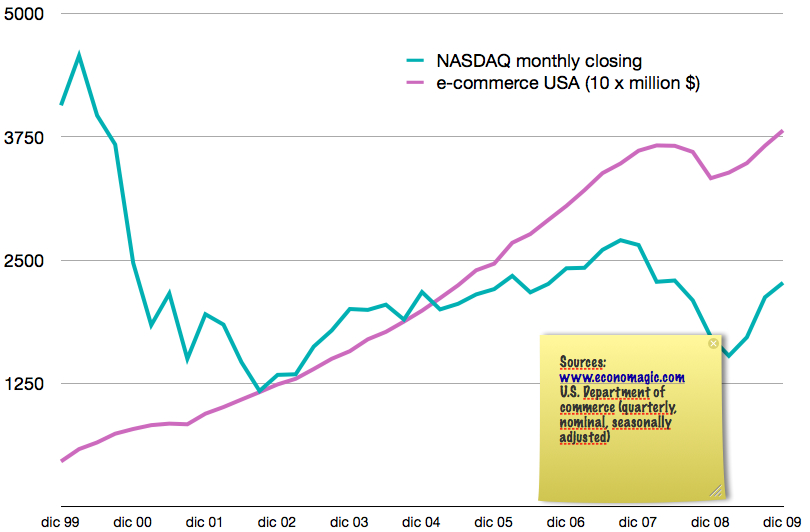
There is no obvious reason why this should happen. The second Perry-Lester invention, Home Aware, has been very successful, shipping a million units in six weeks. One would think that, even if the company originally producing it went bust, a competitor would step in to service and expand the existing customer base. After the 2000 dotcom bust consumers actually increased their use of the online services that they found useful, undaunted by their association with dotcoms. Yahoo, Google, Amazon and the like continued to prosper in their respective markets, if not in the stock market. I looked at time series data for NASDAQ and e-commerce sales over the period 1999-2009; the correlation between them is practically nonexistent (negative, in fact), as you can see from the following graph:

So, is the innovation society sustainable in Makers?

Sustainability questions are tricky. Time and again, scientists from have made doomsday predictions that went viral as public opinion found them really convincing, but later turned out to be way off the mark. From Malthus to the Club of Rome and the Millennium Bug, we seem to have a bias towards underestimating the adaptability of our society and its economy (cultural change makes the birth rate drop, raising prices of oil increase the energy efficiency of GDP and so on). Doomsday feels right at some level: it may just be a heritage of our Neolithic past, or a very deeply ingrained cultural myth (Apocalypse, Ragnarok etc.). Certainly that suggests a lot of caution in predicting it.

The economics of New Work are at least plausible; its downfall is the least plausible of its features. I was expecting something like Kodacell and Westinghouse spinning off their New Work branches, or selling them to more nimble, lower overhead companies that would commodify the networked organization and finance that the giant companies have to offer. The history of open source has already shown that you don’t really need a large company to achieve coordination, after all. The book, however, ends on a deeply pessimistic note: the large evil company has won the battle against the ride movement and recruited Lester, neutralizing his innovative potential; Perry has become a sort of wandering troubleshooter, lonely and poor. Doctorow the economist seems to be supportive of the innovation society, but Doctorow the author definitely is not. I wonder – really wonder – which if the two Doctorows will be right in the end.

August 30, 2010     Alberto     complexity economics, industrie creative e sviluppo     comment

Lies, damned lies and infographics: implications for open data policies

Sorry, this post in Italian only. For an automated translation cluck on the “translate” link.

Come molti altri, sto cercando di farmi un’idea sulla morte del web profetizzata da Wired. Se mi viene in mente qualcosa di sensato da dire in merito lo farò. Per ora la cosa che mi sembra più urgente è lanciare un “allarme infografiche”.

L’articolo di cui tutto il morituro web sta discutendo si apre con una bellissima infografica colorata in perfetto stile Wired (questa qui a sinistra), in cui si vede bene che la quota del traffico internet (cioè pacchetti di dati TCP/IP) attribuibile al web è in calo: da questo calo parte la discussione. A questo punto, Rob Beschizza su Boing Boing ha provato a ridisegnare il grafico partendo dagli stessi dati (la fonte è Cisco) ma in valore assoluto, tenendo conto che il traffico web si è moltiplicato per un fattore centomila dal 1996 al 2005, e il traffico Internet si è moltiplicato per un fattore sette dal 2006 al 2010. Il risultato è che il web non solo cresce, ma cresce a una velocità crescente. Il grafico è risultato così:

Oltretutto, diversi commentatori hanno osservato che misurare l’uso di internet in consumo di banda, invece che – diciamo – in tempo di fruizione sopravvaluta l’importanza degli usi multimedia (video e VOIP) rispetto a quelli basati sul testo (email).  Tutta la discussione di Anderson assume un sapore completamente diverso: è comunque intelligente e argomentata, ma perde l’aura profetica, e anzi sembra un po’ una roba furbetta e vagamente interessata.

Non saprei dire se il web è morto o meno, ma sono abbastanza sicuro che è il momento di farsi qualche domanda seria sulla visualizzazione dell’informazione. Negli ultimi anni si è lavorato molto su questo tema, a partire dal presupposto – corretto – che l’evoluzione ci ha dotato di un cervello molto veloce nell’elaborare gli stimoli visivi.  Un grafico a torta comunica in modo molto più immediato di una tabella o, Dio non voglia, di un’equazione. A partire da questa considerazione uno dei miei eroi, il pioniere dei computers Douglas Englelbart, finì per concepire i computers come macchine con cui comunicare tramite un’interfaccia grafica. Le infografiche sono una punta avanzata di questo movimento, metà informazione, metà arte.

Ma forse l’elaborazione più lenta ha anche un vantaggio: ci permette di prendere un po’ di confidenza con il dato, di esaminarlo con un minimo di distanza critica. L’immagine, ancora di più del dato, ha un potere seduttivo che può essere strumentalizzato, e spesso lo è. Nel campo specifico degli open data, cioè dell’apertura e diffusione delle basi dati delle autorità pubbliche, Daniel McQuillan (tra gli altri) ha avuto modo di commentare che la visualizzazione, proprio per questo motivo, finisce per non dare trazione alle comunità.

Alle tre categorie di menzogne di Sir Charles Dilke — bugie, maledette bugie e statistiche — se ne potrebbe aggiungere una quarta, quella delle infografiche: che sarebbero poi menzogne al quadrato, perché già si basano su dati “massaggiati” (la scelta di Wired di usare quote di banda anziché valori assoluti secondo me è furbetta, scandalistica e in definitiva in contrasto con la deontologia dei giornalisti)  e ad essi aggiungono la seduzione delle immagini e del colore. Vabbeh, direte voi, è Wired, mica l’American Economic Review, serve a fare un po’ di chiacchiere al prossimo aperitivo. Mica tanto, perché l’argomento trattato è politicamente molto carico, e vengono dichiarati vincitori Jobs, Zuckerberg e i sostenitori degli ecosistemi chiusi. Se noi ci comportiamo come se la previsione fosse vera, contrinbuiremo a farla avverare, comprando iPad e apps. L’orientamento “leggero” dell’opinione pubblica non è privo di conseguenze, come si vede bene nella politica italiana.

Conclusione 1: come al solito, non ci sono pranzi gratis. L’abilità del cervello nell’elaborare stimoli grafici lo rende anche più vulnerabile ai tentativi di influenzare questa elaborazione. Conclusione 2: se qualcuno vuole convincervi di qualcosa, e a sostegno delle sue conclusioni tira fuori una grigia, brutta tabella in bianco e nero è probabile che abbia in mano qualcosa: se tira fuori una bella infografica professionale e colorata, beh, meglio stare in guardia. E tenere d’occhio il portafoglio.

August 23, 2010     Alberto     complexity economics, internet     3 comments | show

Figuring out money to understand the world

It had to happen, sooner or later: money and finance are the most highly visible among the many topics of interest to economists. Since I am an economist, and easily accessible through this blog and my social media presence, Wired’s Fabio Deotto asked me for a comment on a piece of financial news: apparently Facebook is considering bringing Credits, the virtual currency used for buying Facebook apps, to the wider world as a universal means of payment. Is it possible to leverage Facebook’s 500+ million users to launch a new global currency and revolutionize the world of finance?

In the best tradition of economics, my answer was that the question is wrong, for many reasons: there are already dozens of virtual currencies that work quite well but did not revolutionize anything; currencies need to be aggressively backed by reserves and open market operations, or they’ll depreciate; credit card companies have already in place globally accepted virtual money operations with many more users than Facebook — only in the USA there were 1.3 billion credit cards in 2006 (the full article, in Italian, is here. But the real answer is that I know nothing about finance, so I recommended that Fabio talk to a real money expert.

This made me realize that not knowing anything about finance is a bad idea for an economist as of 2010. The rising tide of social innovation contains a lot of financial innovation: just think of internet-based microlending agency Kiva; of Italian “community lending” platform Del community lending dell’italiana Prestiamoci; of crowdfunding services for the arts; of Solidarity Purchasing Groups, another Italian invention (yes, Italians, seem to be right on the frontier of social financial innovation). My conclusion: time to go back to studying money. Money is difficult, counterintuitive: its hard to figure out just what it is and where it draws its magical powers to get us the things we need. Can anybody suggest a book to start from? Rigorous, but starting from the basics, ideally with a historic approach? I tried reading Niall ferguson’s The Ascent of Money, but that’s maybe not advanced enough. Thanks in advance for any suggestions you might pass along!

August 10, 2010     Alberto     La vita, l'universo e tutto quanto     3 comments | show

La lunga marcia di CriticalCity (e alcune considerazioni di sistema)

Il progetto CriticalCity è molto vicino al mio cuore: incubato in Kublai, vincitore del Kublai Award 2009, ho l’onore di servire nel suo advisory board. Dunque sono stato felicissimo quando il CEO Augusto Pirovano mi ha dato la bella notizia: Fondazione Cariplo ha accettato di finanziare il suo progetto Upload, la “versione aumentata” di CriticalCity, concepita dai ragazzi l’anno scorso in una lunga sessione di lavoro con il gruppo di SF0 a San Francisco. Il progetto vale 300mila euro su due anni; la Fondazione lo cofinanzia al 70%. Per ora ha stanziato il contributo per la prima annualità (110mila euro); sembra disposta a erogare i rimanenti 90mila l’anno prossimo, se la performance del progetto sarà soddisfacente. Si tratta del finanziamento maggiore deciso in questa tornata.

Consumati i festeggiamenti, mi resta da fare alcune considerazioni sull’ambiente in cui CriticalCity – come qualunque nuova idea di impresa – è riuscita a compiere il difficile passaggio da idea a impresa.

Primo. Il percorso è troppo lungo. CriticalCity è in pista da tre anni e mezzo; ha iniziato il percorso di Kublai un anno e nove mesi fa; ha messo a punto l’idea di Upload da un anno. In tutto questo tempo, naturalmente, il progetto non ha prodotto un euro di ricavi, ed è stata molto forte la tentazione di buttare tutto alle ortiche e mettersi a cercare un lavoro qualsiasi. I ragazzi sono stremati: hanno tenuto duro, ma questo non era scontato. Fare un’impresa richiede sacrifici, siamo d’accordo, ma per la società non è un bene che questi sacrifici siano così tanti.

Secondo. Il processo di selezione dei progetti della Fondazione Cariplo è efficiente e trasparente, strutturato in modo da attirare molti buoni progetti ed elevarne la qualità in itinere, senza burocratismi inutili. Quando scade il bando? Non scade, quando sei pronto ci mandi il progetto, ogni qualche mese ci riuniamo e valutiamo i progetti che sono arrivati nel frattempo. Quanto sono grandi i progetti che finanziate? I progetti sono tutti diversi, quello che vogliamo vedere è congruità tra le attività da finanziare, gli obiettivi e il budget. Ah, e non buttarti a scrivere cinquanta pagine: mandaci una pagina e mezzo per email, poi ti chiamiamo noi, fissiamo un appuntamento e ti diamo qualche indicazione per aggiustare il tiro (Augusto è stato chiamato il giorno stesso in cui ha inviato il preprogetto di Upload!). Mi risulta che il modello di valutazione Cariplo sia considerato il più avanzato in Italia, e che la Fondazione per il Sud lo stia studiando per adattarlo al proprio mandato.

Terzo. Non bisogna sopravvalutare il ruolo del venture capital in un sistema per l’innovazione. Naturalmente il venture capital ci vuole e come. Solo che non è adatto a tutte le idee innovative, ma solo a quelle in grado di generare profitti in un orizzonte breve o medio – il che purtroppo esclude molte idee veramente visionarie e generative di ecosistemi, come Internet stessa che infatti è un progetto governativo. Nel percorso di CriticalCity il venture capital italiano ha giocato un ruolo – mi dispiace dirlo – peggio che inutile. Non tanto perché non vi abbiano investito: anzi, hanno fatto bene, perché avrebbero dovuto investire in un progetto not for profit? E del resto, Augusto e compagni, molto consapevoli che CC è un’idea profondamente non profit, non glie l’hanno neppure chiesto. Il problema è stato piuttosto che a TechGarage 2009 diversi VC nostrani si sono impegnati pubblicamente a finanziare CC anche a fondo perduto. Molto pubblicamente: vi consiglio il video, davvero impressionante.

Nòva 24 ci fece la prima pagina, con i Critical sorridenti. A quel punto, però, il percorso si è fatto poco chiaro: sì, vi finanziamo a prescindere, però fate una srl, facciamo non profit ma lasciamoci aperta la porta al for profit. Nel frattempo preparate un piano finanziario, riscrivete il business plan, non ci siamo ancora…

Questo ha generato confusione e fatto perdere molto tempo ai ragazzi: nell’autunno del 2009, come era prevedibile, si è capito che non è il mestiere dei VC investire in progetti non profit, e non è sicuramente il loro mestiere lavorare direttamente sul cuore delle idee di impresa, che devono invece essere espressione degli imprenditori. Uno a uno, i VC hanno ritirato il loro sostegno a CriticalCity. Purtroppo di questo passaggio i media e i blogger che si occupano di innovazione non hanno parlato: e invece è importante, perchè è una storia istruttiva per i creativi e gli imprenditori che hanno un’idea nel cuore, e per i VC stessi. La sua morale è che non tutti i canali di finanziamento vanno bene per tutti i progetti, e che il mondo delle startup, al di là della retorica, non serve a fare innovazione, ma serve a fare soldi in fretta attraverso l’innovazione. Che va benissimo, ma è diverso.

June 18, 2010     Alberto     industrie creative e sviluppo     8 comments | show

Ho cambiato idea su Wired Italia

Sono abbonato a Wired e vivo in Italia. A inizio 2009, quando la rivista ha lanciato l’edizione italiana mi è venuto naturale comprare i primi numeri con curiosità e simpatia.

Però non mi convinceva. Gli articoli tradotti dall’edizione americana erano in genere belli, ma li avevo già letti mesi prima. E la parte della rivista fatta in Italia mi sembrava un po’ troppo leggera, troppo concentrata sul lifestyle. Della Wired originale mi piaceva l’orgoglio geek, la noncuranza anche un po’ arrogante con cui si attaccavano argomenti anche complicati (dalla teoria dei grafi alla genomica o lala crittografia), l’insistenza sul do-it-yourself. L’edizione italiana mi sembrava interpretare quella cultura in un modo un po’ fatuo, un po’ modaiolo, stando accuratamente lontani dalle cose che molti trovano difficili e noiose, ma su cui i geeks invece riversano un’attenzione spasmodica. Della Wired originale mi rimanevano i riferimenti a Star Trek e i gadget per feticisti, ma non il nucleo di scienza dura, che invece, per me, distingue quella rivista dal mare delle altre. Si vedeva bene dalla pubblicità: la rivista americana è piena di trapani e attrezzature per il bricolage, quella italiana di auto e moda. Ne uscivano stereotipi sgradevoli ma, ahimé, plausibili: gente del fare gli americani, consumatori narcisisti e inetti gli italiani. C’è da stupirsi se ho continuato a comprare la Wired americana?

Dopo un anno, però, mi devo ricredere. Wired Italia ha trovato una chiave, che mi sembra essere quella della militanza. Più o meno dall’autunno 2009 in poi la rivista ha promosso in modo sempre più aggressivo l’Italia della conoscenza: ricercatori, tecnologi, imprenditori visionari. Nel fare questo tocca corde profonde nella storia economica del nostro paese: la saga dell’italiano dall’inventiva genialoide e le mani d’oro ci è familiare fin dal Rinascimento, e storie come quella del piccolo imprenditore che inventa una tecnologia per portare la banda larga low cost con ponti radio ricordano gli articoli che il mio indimenticato maestro, Sebastiano Brusco, scriveva negli anni 90 per Il Sole 24 ore. Le storie italiane sono sempre di più (tre articoli importanti e diversi più brevi nel numero di marzo), e aumentano le infografiche dense di dati e contenuto. E soprattutto, la rivista ha dato il via ad una discussione globale candidando internet al premio Nobel per la pace (più militante di così…). La pubblicità continua a essere prevalentemente lifestyle, ma non si può avere tutto.

Quella di Wired Italia è un’operazione  ideologica, ovviamente. Ma va bene così, perché la rivista promuove la nostra ideologia, quella che dice: l’innovazione, la conoscenza, la condivisione, l’esplorazione delle infinite possibilità che ci stanno di fronte sono un bene in sè. Come tutte le ideologie, questa non è negoziabile, non importa cosa ne pensi la maggioranza silenziosa. Sento Wired molto vicina a questo atteggiamento, e quindi mi ci ritrovo. E la compro, e la leggo volentieri.

Quindi faccio ammenda. Give credit where credit is due: Wired Italia è una rivista interessante, e nel mercato italiano ha un senso profondo, anche identitario se volete: fatti i dovuti distinguo, svolge il ruolo del Manifesto degli anni 80, o di Vie Nuove degli anni 50. Quando la vedi sbucare da una messenger bag, sai che hai davanti una persona che, almeno, ti risparmierà i soliti luoghi comuni su Internet piena di pedofili. Di questi tempi e in questo paese non è poco.

March 25, 2010     Alberto     industrie creative e sviluppo, vita digitale     1 comment | show

Obama’s data and Clarke’s first law

As was expected, Wired’s June issue has a story about Vivek Kundra, the first-ever White House Chief Information Officer. The Obama administration’s vision on federal data release in a machine-readable, user-rateable and taggable form is indeed very fascinating.

Towards the end of the interview, almost as a side to the main topic, the interviewer asks this question:

As CTO of Washington, you moved tens of thousands of employees from Microsoft Office to Google Apps to save money. Part of your new agenda is shifting the government to cloud computing and using free software. How will that happen?

I had missed it: in October 2008, as Obama was busy with his campaign, Kundra worked as Chief Technology Officer of District of Columbia. In that capacity, he moved 38,000 employees of the District’s administration from Microsoft Office to the Google cloud suite, obviously saving quite a lot of taxpayer money.

The problem with this story is that it looks like a theoretical impossibility. Incrementalist thinking – Yale’s Charles Lindblom being its most prestigious academic – is extremely influential in the American political science tradition. Incrementalists looked up deep, important reforms like the introduction of the Federal budget under the Roosevelt administration, and concluded that reform happens in small steps, aiming for what is possible, i.e. “the present situation plus or minus five per cent”. Migrate 38,000 employees from a system to another, mister Kundra? What about trade unions? And suppliers? How can we train employees for the new system? How can we get the middle management’s consensus? Trust us, mister Kundra, it can’t be done. Let’s do a pilot project instead, or a feasibility study. Something more… realistic. Incremental.

The incrementalist position – which I respect deeply – remind me of Clarke’s first law: when a distinguished but elderly scientist states that something is impossible, he is very probably wrong. Did Kundra ever read Lindblom? Did he know his reform was impossible whan he went ahead and did it? He made it happen anyway. I wonder whether a little less of scientific realism and a little more healthy recklessness would not be a better recipe for reformers all over the world.

July 19, 2009     Alberto     industrie creative e sviluppo     5 comments | show

Spiegarsi la crisi, spiegare la crisi

In un godibilissimo articolo, Enzo Rullani si interroga sulla crisi economica, e si smarca dal dibattito in corso tra neostatalismo e neoliberismo, che secondo lui sono entrambe ricette del secolo scorso. A un certo punto si incontra questo passaggio:

Chi può credere che il terremoto a cui stiamo assistendo sia frutto della sbadataggine di chi ha concesso i mutui subprime a debitori che non li avrebbero restituiti o a furbacchioni che – come tanti altri prima di loro – hanno speculato al rialzo sulla finanza facile, vendendo promesse che non erano in grado di mantenere?

La domanda è retorica, ovvio. Secondo Rullani le vere ragioni della crisi stanno sul piano del modello di sviluppo, non su quello delle tecnicalità finanziarie. Però ha una risposta non retorica, che è “parecchia gente”. Da Wired a Daniel Kaufmann, passando per Lavoce.info, sono molti i commentatori che hanno affrontato il tema senza ricorrere a spiegazioni sistemiche. Tutti questi dicono un po’ la stessa cosa, cioè che i derivati finanziari sui mutui subprime erano rischiosi, ma (a) questo rischio era difficile da percepire senza disporre di nozioni non elementari di teoria della probabilità e (b) banche e intermediari stavano facendo troppi soldi per avere veramente voglia di studiarsi il problema. Come ha scritto Taleb in The Black Swan, gli umani non sono cablati per capire la matematica probabilistica: preferiscono il pensiero magico. Esso, unito agli effetti aspettative – cioè a quei meccanismi che fanno sì che l’economia sia così piena di profezie che si autorealizzano – fa un bel po’ di strada nello spiegare la crisi in atto.

I punti di criticità individuati da Rullani mi sembrano molto sensati…  ma non c’è bisogno di invocarli per spiegare questa crisi. Il rasoio di Occam li taglierebbe via: a parità di fattori, la spiegazione più semplice tende a essere quella esatta. Inoltre, se si vuole capire davvero, il terreno delle tecnicalità va accettato: in altre parole – e come sempre – bisogna studiare per farsi un’idea propria. Per questo guardo con simpatia e gratitudine a chi fa uno sforzo per spiegarsi e per spiegare con chiarezza i meccanismi concreti della crisi, anche se noiosi e difficili. Come in questo video:

March 9, 2009     Alberto     industrie creative e sviluppo     comment

ma tu che lavoro fai? (parte seconda)

Non l’ho postato prima perchè avevo paura di abbassare il livello dell’interessante discussione sul rapporto fra arte e mercato, ma visto il tuo ultimo post “mi sono tranquillizzato” … :)

Riguardo al problema di ogni persona che lavora nel mondo della creatività/IT/hi-tech/etc. di spiegare che lavoro si fa in 3 parole, del quale ha già parlato Alberto qui, segnalo sul blog di Bruce Sterling questo documento/presentazione dal titolo “the fuzzy tail” commentato da Sterling così:

“This is a classic example of the 21st century dictum that, if you can actually explain what you’re doing, you’ve already been outsourced to India.”

Che dire, questa me la segno, può essere una buona risposta da dare se si è in difficoltà, no?

November 14, 2007     Marco     industrie creative e sviluppo     1 comment | show

Il mio bestseller per il 2008

Molto carina l’idea di Mathew Honan su Wired di ottobre: un generatore di Grandi Idee a cui intitolare bestsellers aziendali (tipo The World is Flat, Wikinomics o The Long Tail). Io ho deciso di scrivere

Community and Meme

The New Radical Force of Humanity

Permanent changes driven by collective power spur innovation, growth, and wealth.

Aspetto un consistente assegno da qualche editore, poi ingaggerò un ghost writer. Non posso fare sempre tutto io. :-)

November 13, 2007     Alberto     industrie creative e sviluppo     comment

Second Life (e Ivan Montis vendicato)

Forse ricorderete che qualche mese fa ho partecipato a un panel sulle nuove tendenze del marketing in rete all’EBA Forum. Uno degli interventi più qualificati dalla platea è stato quello dell’amico Ivan Montis, tra l’altro uno dei magnifici tre di Infoservi, che ha detto in sostanza: mi rifiuto di dare tesi di marketing su Second Life, perche il marketing su SL funziona solo per induzione: non ti fai pubblicità inworld, ti fai pubblicità raccontando a Repubblica che hai aperto un ufficio in Second Life. Il panel era diviso tra SLentusiasti (come David Orban) e SLscettici (come Diego Bianchi), ma con posizioni molto mediate dalla pelle, dall’esperienza personale inworld. Solo Ivan ha tagliato un argomento così nitido e se ne è assunto la responsabilità. E che reponsabilità! Che vergogna, mi diceva una gentile signora incontrata alla macchina del caffè alla fine della discussione, un accademico, giovane per di più, che si rifiuta di prendere in considerazione Second Life!

E invece adesso Wired ha pubblicato un articolo intitolato eloquentemente “Come buttare via milioni di dollari in una Second Life deserta”. Chris Anderson in persona, nel suo blog, fa ammenda rispetto alla credibilità riconosciuta dalla sua rivista e da lui stesso a SL, ci siamo sbagliati, tanti saluti. Ivan, c’eri arrivato prima tu: onore alla tua lungimiranza.

E io? Per una volta ho una posizione un po’ “democristiana”: siccome sono un grande fan di Neal Stephenson sono molto intrigato dal metaverso di Linden Labs, ma che fatica! Che interfaccia rudimentale! Se avessi più tempo, forse sarei anch’io un SLentusiasta (tanto mica devo vendere niente, io), ma per come stanno le cose sono un sottoproletario inworld, con un avatar standard e un account gratuito con il nome di Mister Volare.

August 18, 2007     Alberto     industrie creative e sviluppo     2 comments | show


© Contrordine compagni - Wordpress-Theme 0816 by Netprofit Webdesign & Robert Hartl and personalized by Freddy