pubblica amministrazione


Zen and the art of website procurement: why bureaucrats should get their hands dirty with technology

In the past few years I worked for several public sector agencies. Much of my work consists of thinking up and delivering projects that happen mostly through Internet channels. This is a good time to take a step back and muse on what I learned. As always, the most valuable lessons come from mistakes made – so it’s a good thing I made a lot of them.

  • Software-as-service is a bad idea, though there are exceptions. My team and I made this mistake with Kublai, as we decided to deploy our platform on Ning. That allowed us to be up and running in half an hour, no small advantage; but we paid for it by sequestering our own database, procured and paid for by the Italian government, and handing it over to an American private company forever. A year later, Ning changed its CEO and business model: it moved its platform from the open source to the full copyright domain, disabled APIs and blocked migration tools. Just to do a network analysis, Ruggero Rossi had to write a web crawler – a bit like picking the lock to the door of our own home. It could have been worse: we were using a free service (that was before Ning rolled out pricing plans). If the company had simply shut down business, formatted the hard drives and walked away we could not have stopped them, since we were not in any contractual agreement. They would not even answer our emails. I am never going to even consider again rolling out a public sector project in which my agency does not have root access to the server hosting the database.

  • Using proprietary software is not a good idea either, again with some exceptions. It is expensive and it amounts to a open-ended commitment to your supplier. If a large software house develops custom software for you and then sells you the license, no one, except that same supplier, is ever going to be able to tweak that code. You risk finding yourself disempowered and stuck in a situation in which changing the color of the background or the font is expensive (as in billable hours expensive) and involves a lot of administrative friction. Furthermore, it is politically questionable: proprietary software is not reusable for free by other administrations, and that is not good – especially in a time of budget cuts and of (justified) skepticism vis-a-vis the effectiveness of administrations in spending taxpayer money.

  • That leaves free/open source software. I have been using WordPress in public sector projects since 2007; for the Edgeryders platform, more or less finished as of this week, my team ventured into Drupal. Working with open source software can be hard and frustrating. Features that are supposed to work simply installing a module or a plug-in turn out to have horrible bugs in practice; everything takes longer that you think; most of the work is not developing, but debugging. Meanwhile, the rest of the projects activities are stalled. It feels horrible. I think experience can mitigate the problem, but never really solve it. Free software is by definition organic and gritty: it works by hacks and duct tape as well as by elegant, rational solutions.

Despite all the problems, my experience of Drupal procurement is going to be positive in the end, as with WordPress before. The reason is this: these platforms allow, and even require, a hybrid figure of “power admin” to emerge, somebody who is less skilled than a developer but more so than a normal user. This happens because the admin interfaces of WordPress and Drupal are intuitive and very powerful; Drupal, especially, allows fine-grained control over your website. You can query the database, format the return of the query and send it to a page, a block or even an email message; you can tell the website to execute instructions of the kind IF [condition] THEN [action], not quite programming but on the border. Furthermore – and here I am thinking about my standing love affair with WordPress – when the admin interface is not enough, it is easy to find online resources and tutorials to get your hands into non-core parts of the code. I am technically incompetent, but still I have been able to teach myself to tweak the CSS in a blog’s style sheet, and even the PHP code for very simple tasks, like assigning different headers to different page or inserting a line of Javascript. That required a small-ish investment, to which the proliferation of “For Dummies” books in my library is testimony. This gives you an incredibly important freedom: that of developing in a quick-and-dirty fashion, launching, and then just keep tweaking as your project evolves. Trust me, you will feel the need from day one.

Here’s the trick: the hackerish power admin role is perfect for a public servant that needs to procure software. Getting to know the architecture of these platforms well and to take full advantage of their scope for customization does not make you developer, but it does mean being able to have a constructive conversation with your developers, get real on what can and can’t be done, how long it takes and how much it costs. Furthermore, a power admin can rethink her goals in terms of the software, and so come up with highly sophisticated terms of service for the procurement effort. For example, on Edgeryders we need to constantly reinvolve users in the conversation: this is done through email notifications and the recent activity feed. In Drupal, these functionalities are carried out by certain non-core modules. If the public servant knows this, she can procure not “a website that feels buzzing”, but “a website in which the activity stream module logs activities that are not logged out-of-the-box”, that is much clearer

When I got into motorcycle riding, I read the obligatory Zen and the Art of Motorcycle Maintenance. The lesson of that book is the following: the act of driving a motorbike is not really separable from that of doing its maintenance. “Romantic” bikers, who do not enjoy getting their hands dirty, don’t accept this, and delegate to professional mechanics even the simplest maintenance operation. But they pay the price of disempowerment, when their machines stop by the roadside and won’t get started again, and they don’t have a clue what’s wrong and how to fix it. This system failure can be disastrous in public policy: in the projects I manage technology typically accounts for less than 10% of the budget, yet if the technology is not there the entire project grinds to a halt.

Summing up, high quality procurement is impossible until you know what you are buying. In my experience the free/open source software community is up for sharing its knowledge; corporates producing proprietary software much less so. If, like me, you find yourself in the position of procuring a simple technological solution for the public sector, I recommend you turn to this community, arm yourself with patience and get your hands dirty with the technology the developers intend to use. Install and configure sandbox sites, add functionalities, tweak their look and feel. Spend time with hackers, show that you are eager to learn, an grill them with questions. Above all, don’t yield to the temptation of going “this is not my job, just make it work and send me the invoice”. It doesn’t work like that. This is very time consuming, but you will save that time, with interests, once you are in production. I know it’s not a perfect system, but it is still better than available alternatives. Truth be told, I think it would be really useful if somebody started a course of website procurement for public servants. Anybody out there is interested? I would certainly sign up.

Thanks Freddy Mascheretti, Ivan Vaghi, Paolo Mainardi and Claudio Beatrice for their patience and suggestions
December 5, 2011     Alberto     e-government 2.0     16 comments

The rise and fall of Kublai: the difficult interface between bureaucracies and networks

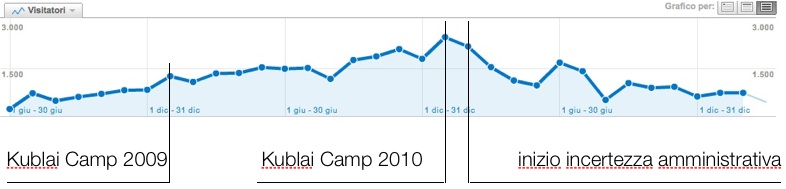
I have resigned as director of Kublai, the first web 2.0 project of the Italian central administration. My directorship had been an interim one for the past year: the Department for development policies of the Ministry of economic development, Kublai’s home base administration, has initiated a procedure for launching its final year and recruiting a new director, but the procedure met several difficulties and is still pending, after more than a year. The officer in charge of Kublai, Tito Bianchi, had asked me to stay on and bridge this gap, so I ended up with an unpaid role of interim director. Meanwhile the Department itself had to face a crisis, not directly connected with Kublai; as a consequence, starting in February, Tito’s contract was not renewed. In this new situation I did not feel like I could stay on, even as an interim director. I still hang out in Kublai as a member of the community, and still learn a lot from Kublaians. I am extremely proud of the liveliness the community displays even in difficult times: in these ways we are discussing whether to spin it off from government project to the third sector. If it works, it will be very unique: a demand-driven policy spinoff! And even if it fails, it will make for an extraordinary experience trying it. I am very grateful to the Department for the opportunity to develop such an advanced project.

Over and above the role I played in it, Kublai’s story seems to be representative of a tough problem in public policy: administrations find it hard to manage the interface with the online communities they collaborate with – even if they originate them. Online public policies can be incredibly efficient, because they enable citizens to contribute by taking actions — I should know, since I have designed and delivered more than one. In March 2009, ten months after kickoff, an independent study showed that two thirds of the comments feeding into business plans writing came from the community itself, and only one third fron the project’s paid staff. The key to high efficiency is the community’s activism, and community ties can break down if they are not lovingly maintained. A decrease in the credibility of the founding group, or even simply a slump in alertness, might take away the motivation to participate at any time.

In the last few years I spent a lot of time thinking very hard about policy communities, especiallty those that live online, and I learned much. It turns out that running them effectively requires some conditions to be met:

  • an adequate planning horizon; if you need three years to build a resilient community, you have to have three years of guaranteed operations. Stopping before achieving your goals means wasting all of the resources invested.
  • radical transparency: access to what goes on behind the scenes has to be allowed to those interested (and not imposed to those who are not). Active participation requires participants to feel ownership of the project, and we don’t feel that if we think we are not being told the whole story.
  • low costs: a project based on voluntary work needs to show volunteers that its staff brings to the table a value worth the resources paid to it in salaries. This is a sensitive point, because the collaboration between staff and community is inherently unequal — we collaborate, but I get paid and you don’t — but, if the staff works well and hard, it is still acceptable. Justifying high overheads, on the other hand, is really hard. Every penny that goes down that route instead of the project’s own activities weakens its credibility.
  • fast delivery, with little or no timeline uncertainty, and therefore streamlined procedures. Social dynamics in online communities are fast and inherently emergent, which means you cannot control them top-down. When stuff happens, it happens, and you have to act. If something needs doing now, you need to be able to go out and do it now. If this is not possible, you need to commit to a date for it to get done. “We don’t know, we are waiting for a green light From On High” destroys credibility, hence participation, hence efficiency,
  • lowering the barriers between paid staff and the community. People participating to an online community on a voluntary basis make great candidates to become its staffers. They know it well and love it, they share its meeting places and times. conversely, many public sector employees are harnessed by rigid office hours and badges that keep track of the time they spend in the office; many more are sequestered behind corporate firewalls that inhibit the use of social networks (major tools of this particular trade). Requiring a person in this situation to work on a project like Kublai means asking for trouble.
  • All of the above requires a lot of management leeway; this makes it inevitable that the assessment of these projects is carried out by weighing its results rather than checking its conformity to procedure.

Unfortunately, these conditions do not match well with the work style commended to Weberian bureaucracies — and most public administrations are Weberian bureaucracies. In the case of Kublai:

  • it has not been possible to guarantee the planning horizon. As we prepared to launch, the Department decided to unbundle it into three steps, one per year. The reason: a three-year project would have required a European tendering process, that was estimated would require a year and a half. The results: at the second year the project was funded, but in a way that undermined its effectiveness (see below) and with a gap of three months for formally reinitiating the project and seven months to actually go out and do stuff; for the third year we designed an architecture that was on paper more effective and used two delivery channels, but one of them was never initiated. My personal history is a sign of the stop-and-go nature of administrative processes: I directed Kublai for three years, and I had a regular contract for a total of sixteen months. The remaining twenty months were interim.
  • full transparency is technically difficult. Even when public decision makers have the best intentions, they live in a system so complicated as to be incomprehensible for the uninitiated. For example, Kublai’s first year was delivered through an in-house company of the State, Studiare Sviluppo. In its second year, the Department’s legal office changed its mind and claimed that would not be possible: though Studiare Sviluppo and the Department itself have a common origin in the Ministry of the economy, the creation of the Ministry of economic development in 2006 (which contains the Department, but not Studiare Sviluppo) had created a rift between the two organizations. Delivery would have to go through Invitalia, another in-house of the State. This distinction is difficult to understand, so much that it remains controversial within the Department: in 2009 some of its programmes continued to flow through Studiare Sviluppo, but not Kublai. How do you tell a story like this in the “About” page?
  • costs tend to balloon. Kublai 2009 had a higher budget than its 2008 version, but its effectivess seemed to decrease. Why? Partly because the overhead had gone up. Studiare Sviluppo charges 15% of the project’s budget to take care of all the administrative details; Invitalia’s overhead is more difficult to estimate and it varies from one project to another; with exceptions, it seems to oscillate between 30 and 40% (source: talks with several employees and former employees of the Department. I asked Invitalia for a precise figure, and am waiting for a precise figure).
  • decision making always takes a long time, and it is always subject to uncertainty. To give you an idea, Kublai 3 should have started in January 2010. The idea was to activate a project, led by Invitalia, and use that as co-financing of a larger project, funded by the European Regional Development Fund. This, however, would have required a change in Invitalia’s accounting system (in ERDF projects human labor must be accounted for as a direct cost, excluding overhead). In May we realized that Invitalia could not or would not make this change fast enough (I’m told they are still in the process). Tito had to initiate a second procedure which tapped into a different financial source; this new procedure was launched in June, but moved very slowly, with a lot of backtracking and all kind of pitfalls springing up, without us apparently being able to see them coming and avoid them. We thought it would be over in September, then in November, then in February, and we turned out to be wrong every time. In February Tito and I agreed to come out. The truth is that no one can tell what will happen and when.
  • in Kublai’s first year we used Studiare Sviluppo’s flexibility to recruit our staff directly from the community. We used very small contracts that recognized and encouraged voluntary work without forcing creatives to turn themselves into consultants to the public sector to work at Kublai. The vision behind this was to lower the barriers between “professionals” and “committed citizens”, and to build an ethics of fairness, where it could not happen that two people would be doing more or less the same work with one of them getting paid and the other one working for free. Starting in 2009 this process stopped: Invitalia’s internal rules dictate that only a small part of a project’s budget can be outsourced (15% of the budget in the case of Kublai); what’s more, it’s normal for recruitment procedures to take months, and even the smallest contract has to be signed by the CEO. Result: the administrative load of many small contracts was simply unsustainable. We had to retreat into a polarized version of the staff: on one side professional business plan advisors (public or quasi-public employees, who typically appreciate the stability a steady job gives them, and have little or no firsthand experience of business creation, let alone in the creative sectors), on the other side the creatives from the community, that we could not even cover travel expenses of if they held a presentation about Kublai at a creative industry event.
  • as for evaluation, Tito and I built a structured evaluation activity into Kublai 3, but that’s stuck with the rest of the project: the project is at risk not to be assessed at all.

With all of these problems, it is a wonder that the project was not born dead! If we we got anything at all done (2500 members, 400 projects being discussed and tens of businesses launched are an important result after all) is because some people poured an unreasonable amount of work and passion into Kublai. My staff was very generous, turning from paid staffers to volunteers when contracts expired and were not renewed (I absolutely need to quote Cristina Di Luca, Walter Giacovelli and Marco Colarossi); the officials in charge for Kublai at the Department (Paola Casavola, at the time the director general who made the initial decision, Tito Bianchi, Marco Magrassi and Giampiero Marchesi above all) have been visionary leaders from the policy maker’s side (Tito in particular has really put himself on the line for Kublai); Alfredo Scalzo at Studiare Sviluppo and Nicola Salvi, Federico Venceslai, Angelita Levato and Danila Sansone at Invitalia used all the autonomy their respective organizations allowed them to try and meet this project’s special needs. We have been a kind of pirate ship, part Luke Skywalker and part Dilbert: I remember Nicola posting from his own laptop and through the neighbor’s open wi-fi, because the corporate firewall would not allow him access to Second Life. Despite all of this commitment, we were a competent and motivated crew sailing a leaking ship. When the work input of the non-Invitalia staff, — the least embedded in bureaucratic procedures and way of thinking — was discontinued, Kublai clearly lost momentum.

A conclusion I drew from this extraordinary experience is that the interface between bureaucracy and network is not easy to navigate. Kublai can be viewed as an attempt to coproduce and codeliver a public service — assistance towards business creation — traditionally delivered (not too well) by local offices. It is a very hot theme: it is, for example, one of the key themes of NESTA’s Public Services Lab, that I have been in conversation with lately. From my vantage point at the Council of Europe, all European governments are moving in this direction, to defend the welfare state in the face of a structural fiscal crisis. I predict it will be difficult to get lasting results if the conditions I listed won’t be guaranteed.

I see only a way that they can be guaranteed: a new deal between government and the women and men who work for it. Such a new deal would work like this: administrations have to give trust and breathing space to their servants, be they employees or consultants like myself; and then assess their results, rewarding people who get results and punishing people who don’t. If there are abuses of that trust, they will be dealt with on a case-by-case basis: designing an entire system to prevent abuse is at a high risk to making it too rigid, disabling people to offer their best ideas. Designers of social media have a mantra: if you design a space to deal with trolls, your users will be trolls. Similarly, if you design a system to harness lazy or corrupt employees, your best staff members, frustrated and humiliated, will leave, and you will be left with the lazy and corrupt ones. It’s time to make choices; who will future public policy be designed for?

April 12, 2011     Alberto     e-government 2.0     2 comments

Un funzionario pubblico sotto gli occhi di tutti

Il 2009 ci saluta con un ultimo regalo: il blog del mio amico e collega (di Kublai) Tito Bianchi, che finisce dritto nel mio blogroll. Aprendo il blog, Tito entra nella ristrettissima schiera dei funzionari pubblici italiani che affidano alla rete le loro riflessioni: e si tratta di un ingresso importante, perché il suo profilo è molto alto (lavora all’Unità di Valutazione degli Investimenti Pubblici del Dipartimento per lo sviluppo e la Coesione del Ministero per lo Sviluppo Economico), il che gli dà una prospettiva straordinaria sul sistema Italia. Il neonato blog si chiama, appropriatamente, “Sotto gli occhi di tutti”.

Come bonus aggiuntivo, Tito scrive in uno stile pulito ed efficace molto lontano dal burocratese – anche perché si è formato al MIT. Ha perfino una lista di parole vietate, gustosissima anche se non la condivido completamente. I primi post sono godibilissimi (il mio preferito è quello sul rugby come metafora di ciò che ci piacerebbe che l’Italia fosse). Ne propongo la lettura e il commento a chi segue Contrordine Compagni: i blog di questo tipo ci arricchiscono di informazioni e punti di vista a cui normalmente non abbiamo accesso, e potrebbero perfino aumentare il grado di trasparenza della pubblica amministrazione italiana.

December 30, 2009     Alberto     vita digitale     2 comments

Rewiring the economy to create new commons (long)

CriticalCity‘s victory at TechGarage was simply incredible. For one, it was overwhelming: the Milano-based crew won all three prizes (the first prize; the Wired award; and the users’ award. In fact, several VCs in the room improvised a pool of seed money for funding the startup! This sounds like an urban legend, but it is actually true: read Marco’s report – he was there). On top of that, their project is uncompromisingly not-for-profit (“we can’t and won’t monetize our player’s commitment to improve their cities”, they said), while TechGarage is a sancta sanctorum of for-profit enterprise. Somehow, this coalition of investors and business angels perceived CC as too good an idea not to make it happen.

There is a third reason why this story is incredible. CC does not come out from one of the many startup incubators built by the private sector, like Telecom Italia’s Working Capital. It comes from an environment for designing creative projects launched by the Italian public sector: Kublai, that I have the honour to have designed and to manage on behalf of the Ministry of economic development (presentation in English here). Even Gianluca, Dpixel president and TechGarage patron, got in touch with CC as a member of the Kublai Award jury.

1. Communities, if they are oriented in the right way, can single out the best ideas. Kublai aggregates creative projects, not lolcats videos: they are complex, and their assessment is multifaceted and multidimensional. CriticalCity’s project document is more than 30 pages long with attachments. The Kublaian community’s consensus on CC predicted with great energy and effectiveness what happened at TechGarage and elsewhere.

2. The public sector, traditionally more public goods-oriented than the private, finds itself in a strategic position. Artifacts like Wikipedia, Delicious, Flickr, Twitter have public good nature, i.e. they are resources for everybody to use. Now, public goods are great, but being public means there is no rivalry in their consumption, so they are by definition difficult to monetize. Consequently many great web 2.0 out there have business model problems. This is an opportunity for the public sector, whose very mission is to produce public goods. After the tragedy of the commons started in the 1700s, digital technologies allow today to invert the trend and start creating new commons.

It seems to me that an extraordinary opportunity open up, such as I did not think I would see in my lifetime. We have democratized creativity, so that thinking up ambitious projects like CriticalCity and trying to make them happen has come to be a course of action available to normal young people like Augusto, Duccio, Chantal and the rest of them; we have web 2.0, a very powerful tool for aggregating ideas and people, and maybe now also for selecting the best among them; we are beginningto have a first generation of people that work on the side of public administrations, and understand the language, and can use the tools.

This first generation has today a new mission: rewire the economy to enable the production of new commons. Wikipedia and the rest may have shaky business models, but their value to the collective well-being and global competitiveness is undisputable. A government worth its salt must enable these things. And it can, because it wields very large resources that are normally used in very low productivity efforts: it has been remarked that all projects showcased at Public Services 2.0 put together had the same budget as a single project of the e-participation European programme. We need rewiring the economy to funnel attention and money towards people like the CriticalCity boys and girls, who dream (realistic) dreams of building resources for everyone to use, that for this very reason are difficult to monetize. It is difficult, but not impossible, and we need to do it. I’m going for it. I hope – and I believe – I will not walk this path alone.

May 25, 2009     Alberto     complexity economics, industrie creative e sviluppo     2 comments

The Times They Are A-Changin’?

[segue da post precedente]

Da fine settembre in poi sono però tornate ad arrivare, finalmente, anche “energie positive” su Booster:
-Giovanna (un’allieva dei corsi) ci ha scritto una mail fiume dicendo e chiedendo di non mollare (e la stessa cosa hanno fatto altri allievi incontrati a Pescara dopo le ultime riunioni);
-Filippo Tantillo dell’ISFOL ci ha confermato l’interesse e la volontà espressa da parte dell’Accademia dell’Immagine de L’Aquila (oltre che sua personale) di accogliere la nostra proposta e realizzare un video che racconti Booster (diretto da lui e dai suoi allievi), ci ha incitato a rimanere nel progetto e a cercare di realizzare ciò che è possibile (“sarebbe un peccato…”) e su richiesta di Alberto ci ha messo anche in contatto con i responsabili ISFOL per i progetti in Abruzzo…;
-abbiamo trovato (grazie all’Isfol) finalmente un contatto vero con un “operativo” (co.co.co) regionale. La “storia” è la solita: lui è un appassionato di musica e conosce (musicalmente) Alberto e la scena pescarese coinvolta dal progetto…

Si sente insomma quasi un clima di tifo per noi e per il progetto.
Ora le condizioni sembrano cambiate, i riflettori si stanno accendendo sul progetto, abbiamo avviato contatti e collaborazioni con Dps, Isfol e Regione Abruzzo, abbiamo acquisito competenze di project management anche dal punto di vista della gestione formale dei progetti europei, abbiamo imposto integrazioni critiche ai verbali (da consegnare in Regione) e un nuovo verbalizzatore. Anche le “condizioni di lavoro” presenti e future in Booster e dopo il progetto, sono quindi mutate. Gli altri partners sembrano averlo avvertito (non hanno nemmeno provato a fare proposte di attività alternative alle nostre), ma è importante che le istituzioni vigilino sull’effettiva e “adeguata” realizzazione delle proposte per il project work (non più al livello di quelle avanzate in primavera, ma comunque potenzialemente utili agli allievi e alla nostra rete territorriale di progetto).

Speriamo che questo sia l’inizio di una fase nuovamente vitale e interessante della presenza di The Hub in Abruzzo… The Times They Are A-Changin’?

October 17, 2007     Marco     industrie creative e sviluppo     comment

Decadence – la fine dell’impero degli Enti di Formazione

Il sistema della formazione in Abruzzo sta cambiando. La Regione – che pure non si può vantare di alti standard di efficienza e buon governo – ha decuplicato il numero dei soggetti accreditati, ha imposto la revisione contabile, ha sostituito interamente la dirigenza dell’Ufficio Equal… A tutto questo (e altro ancora) si aggiunge la diminuzione drastica delle risorse comunitarie per il passaggio all’obiettivo 2.

Gli Enti di Formazione sono in ginocchio, commissariati, con buona parte del personale in cassa integrazione e sulla via del licenziamento, ormai senza capacità operativa.

Questo avviene dopo anni di “vacche grasse” sui fondi europei, nei quali queste strutture con un monopolio quasi totale del settore si erano iper-specializzate nel conoscere e rispettare “alla virgola” le migliaia di norme e requisiti solo formali richieste dalla Regione per ottenere i finanziamenti (che “garantivano l’impossibilità” per i soggetti realmente innovativi del territorio di accedere a questo tipo di canali di finanziamento, con un assurdo meccanismo di adverse selection) crescendo a dismisura e puntando ad accaparrarsi fondi in qualsiasi ambito di attività: dall’industria al turismo, dai detenuti ai giovani creativi. E con il tempo sono arrivate ad avere un cinismo (ancora più inquitante se si pensa che sono organismi interni ai sindacati nazionali) nei confronti delle attività che svolgono che li porta a concentrarsi “molto più” sullo scrivere le cose “giuste” con il giusto quantitativo di pagine (in modo da garantirsi la gestione di risorse che permattano il loro auto-sostenimento e quindi la giustificazione della propria struttura e del personale), che hai risultati.

In questo quadro da fine impero, i suoi protagonisti, che pure ne sono consapevoli, sembrano però non voler accettare che tutto cambi (quindi anche loro, pena l’esser messi definitivamente “fuori”), e continuano con i loro modi “da furbi” (che poi diventano spesso) arroganti e cinici a cercare di far pesare un potere che hanno sempre meno, non ammettendo i loro errori e rendendosi protagonisti di altri momenti negativi “da non dimenticare” per la storia del nostro progetto. Ne elenco qui alcuni, presi solo dall’ultimo mese, che mi hanno visto da “protagonista incredulo”:
-la lettera inventata: il 24 settembre il coordinatore manda in allegato una lettera intitolata “Caro Marco” (dai toni amichevoli e pacati) che sostiene di aver inviato il 7 settembre in risposta a una mia mail, non ricordandosi di aver risposto alla mia mail con tutto il partenariato in copia e con ben altri toni due giorni prima, il 5 settembre (gli altri partners, dopo la mia denuncia, non diranno nulla, come se non fosse successo niente di strano…);
-brindisi ai (/alla faccia dei) fondi FSE: il 27 settembre, dopo le polemiche durissime degli ultimi 3 mesi, osservo basito gli altri partners brindare agli Equal (e mi trovo pure “costretto” a partecipare!) e sguazzare nella jacuzzi dell’albergo con vista sul golfo di Palermo (qui invece non partecipo) dopo la “formalissima” (e poco interessante) conferenza chiusa in anticipo dell’ultimo incontro transnazionale;
-i partners non leggono i documenti sul progetto (e alcuni manco sanno cosa sta succedendo!): il 15 ottobre ascolto incredulo a questa domanda fatta da un membro della PS di Booster: “ma cosa ne è stato di quella cosa che si doveva fare quest’estate? quella per la quale eravamo andati da Di Pietrantonio (Assessore ai Grandi Eventi del Comune di Pescara, ndr) … non ho capito perchè non si è fatta…” (si riferiva al project work di Booster, affossato dalla PS a giugno-luglio senza neppure sapere bene di cosa si trattasse – evidentemente il problema non era quello -, come era chiaro dalle ripetute domande nelle riunioni di PS sul “cosa fosse un workshop etc.”, nonostante la spiegazione fosse riportata in tutti i nostri documenti da mesi …);
-tutte scuse?: durante lo stesso incontro, il 15 ottobre, si mette finalmente in chiaro che tutte le nostre proposte non avevano problemi di rendicontabilità, tant’è che si decide di tenerle e – assieme ad altre – di cercare di realizzarle, con modalità diverse però: spezzettate nel tempo e per partner della PS (ovviamente facendo perdere così di fatto molto del senso e della potenzialità che avevano inizialmente). Allora il problema era solo questo, di far cioè tenere ai partner il controllo sul loro budget e su come utilizzarlo?

Non basta però un partner in disaccordo per garantire l’utilizzo “decente” delle risorse sul project work e la realizzazione delle attività in modo “dignitoso”, per ottenerlo e garantirlo è necessario il monitoraggio delle istituzioni, regionali e centrali: il rapporto con “la committenza”, quello che stiamo ricercando da oltre un anno…

October 17, 2007     Marco     industrie creative e sviluppo     1 comment

Mappa della creatività a Pescara

L’ufficio cartografico della regione Abruzzo avrebbe dovuto fare una mappa online con i dati del nostro Atlante della creatività nell’area metropolitana di Pescara, (una hit su Scribd: 1368 views al momento in cui scrivo) ma si è un po’ perso nella burocrazia (bisogna chiedere l’autorizzazione all’ufficio formazione professionale, che segue i progetti EQUAL, e questo pare richieda mesi, anni…. è da gennaio che siamo dietro a questa cosa). Così oggi, in un impeto di do-it-yourself stile punk del 77, mi sono messo su Community Walk e l’ho fatta io. Ci ho messo un’ora, e ho usato un servizio gratuito di meshup del database geografico di GoogleMaps, il che solleva qualche interrogativo sul ritorno effettivo degli investimenti in tecnologia fatti dal progetto di e-government cartografico della Regione Abruzzo.

Siccome aggiornare il sito di Booster è sostanzialmente impossibile (scadute le password Aruba, non si capisce chi ha quelle nuove, la mappa la pubblico qui. Carina, no? Se zoomate, si vede molto bene il cluster della musica nel “quartiere latino” di Pescara Vecchia, sul fiume.

Ho caricato su Scribd una nuova versione dell’Atlante della creatività di Pescara che incorpora queste mappe.

Ideas for planning a weddingCommunityWalk Map – Atlante della creatività nell’area metropolitana di Pescara

October 2, 2007     Alberto     industrie creative e sviluppo     comment

Booster, "meglio di Un Posto al Sole"

Mi trattengo per ora dallo scrivere su questo blog il mio punto di vista completo sulla situazione attuale di Booster perchè mi ci vorrebbe un paio di giorni per farlo e… per altre ragioni. La storia di Booster sta però assumendo tutti gli aspetti di una telenovela infinta (la battuta che lo paragona a Un Posto al Sole è di Elisa), con continui colpi di scena, che da un certo punto di vista è interessante analizzare, ma il fatto di esserci contemporaneamente “dentro” rende la cosa molto stressante e snervante, oltre che rischiosa dal punto di vista finanziario e non solo.

Mi limiterò ad elencare alcuni degli aspetti che mi sembrano più interessanti:
1) esiste una Grande Famiglia degli Enti di Formazione (e dei soggetti ad essi collegati) che ha acquisito competenze di processo elevate sulla gestione dei fondi comunitari. Questa Grande Famiglia si muove in modo compatto nella aquisizione e gestione delle risorse comunitarie: o sei loro alleato, di tutti, o no;
2) se, come è, i controlli della Regione sono solo formali, chi ha competenze procedurali (come scrivere carta in modo che passi i controlli formali della Regione) ha molto più potere (capacità di bloccare e indirizzare le azioni e le decisioni) all’interno della PS rispetto a chi nel processo mette i contenuti e le azioni “vere”. Allo stesso modo grande enfasi nella discussione delle azioni da realizzare viene data alla loro “presentazione formale/rendicontabilità” (secondo le prassi consolidate) e molto poca alle azioni in se e agli obiettivi e risultati delle stesse (da notare che si sta parlando di progetti che dovrebbero essere innovativi e di sviluppo, quindi in qualche modo di rottura rispetto al passato);
3) il progetto è sempre strettamente legato al contesto, e il contesto in questo caso è fatto di ritardi cronici e strutturali (qualsiasi cosa è gestita in emergenza all’ultimo minuto e oltre), di inefficienze delle strutture pubbliche e para-pubbliche (per non dire di peggio), etc. E’ importante conoscerlo, capirlo, e in una qualche misura accettarlo, senza però rassegnarsi.
4) Esiste infatti una difficoltà di relazione e comprensione fra i soggetti del territorio, nel nostro caso spesso del Mezzogiorno d’Italia, e chi viene “dal Nord” e cerca di portare un modo diverso di lavorare e vedere le cose. Spesso si viene guardati con diffidenza e in caso di conflitti liquidati con un “non potete capire… qui non funziona così…”. La strada per il cambiamento è quindi molto difficile (ma non impossibile, citando Seravalli) e impervia.
5) E come sempre nelle relazioni umane, i rapporti fra due o più soggetti sono fragili: lungo e faticoso è il tempo che serve per costruirli, molto breve quello necessario per infrangerli. Dopodichè è molto difficile ricomporli. E i progetti vivono di relazioni umane.
6) Concordo su quanto mi dicevi ieri: la perdita di fiducia dell’associazione Pescara Duepuntozero (associazione di imprese e soggetti che si occupano di creatività a Pescara, nata su proposta e iniziativa di Booster) e dei soggetti che la compngono verso il progetto e le istituzioni in generale, a causa dei problemi dello stesso e del comportamento di chi lo gestisce, è una perdita per il territorio e per tutti. Sarebbe un vero peccato se il loro contributo allo sviluppo, in termine di energie e competenze, andasse disperso.
7) E concordo quindi anche sulla grande soddisfazione nel sentire i rappresentanti dell’associazione Pe2.0 dire: “ok, sentiamo quello che ci viene proposto ora da questi enti di formazione – che mai abbiamo incontrato prima – ma devono venire loro alla nostra assemblea, e farci proposte per noi interessanti. Se non vengono allora vuol dire che a loro non interessa e quindi neanche a noi, non abbiamo bisogno dei loro soldi, per noi il lato più importante del progetto è stato farci conoscere e far nascere l’associazione e le collaborazioni fra i suoi componenti.”

per ora mi fermo qui, a breve altre riflessioni…

September 16, 2007     Marco     industrie creative e sviluppo     1 comment

Positivo incontro con Tiziana Arista, responsabile della Programmazione e Sviluppo della Regione Abruzzo

Come previsto da Anna Natali (vedi post precedente), Tiziana Arista si è dimostrata molto interessata alle nostre proposte, soprattutto alle ultime due relative all’hi-tech, e ha detto che verificherà (con i responsabili regionali competenti) sia la possibilità di realizzare il wireless gratuito a Pescara, che i possibili sviluppi del progetto Citt@dino+ (contattattando il Comune di Francavilla), che infine l’ipotesi di un bando a livello regionale su questi temi.
Contestualmente si accerterà anche della disponibilità di fondi (Docup2000-06) per finanziare il festival di musica e tecnologia che Pescara 2.0 co-produrrà assieme a Booster a settembre con l’appoggio (e il marchio) dei Giochi del Mediterraneo.

Le prospettive ci sono, ora si tratta di mettersi a lavorare per realizzarle…

June 12, 2007     Marco     industrie creative e sviluppo     1 comment

Azioni per lo sviluppo della scena creativa nell’area metropolitana di Pescara

Il 6 giugno abbiamo fatto un bell’incontro di verifica e approfondimento delle prospettive post-Booster. Presenti Anna Natali di Studiare Sviluppo/Ministero dello Sviluppo Economico, il Consigliere Comunale Imbastaro (anche consigliere del Cda del Comitato dei Giochi del Mediterraneo), Palmina Romano dell’Assessorato alle Politiche Comunitarie, Claudia Civitarese dell’Assessorato alla Cultura, Giulio Berghella e Umberto Palazzo dell’Associazione Pescara 2.0, Dino D’Onofrio e Pierpaolo Marinucci del Web&Music Festival e Comune di Francavilla, Vincenzo Andrietti del Soundlabs Festival e diversi responsabili di Enfap e Smile (enti di formazione che hanno promosso e gestito Booster), oltre ovviamente ad Alberto, Elisa e me.

Si è discusso delle quattro proposte “sul tavolo”: (1) un centro culturale, (2) eventi di dimensione sovralocale, (3) creare una rete wireless gratuita a Pescara che i creativi possano “riempire” di contenuti e progetti di comunicazione per la città, (4) formazione agli operatori e alla cittadinanza all’uso di strumenti collaborativi web-based per la progettazione partecipata.

L’opinione condivisa da tutti emersa dalla discussione è stata: tutte buone idee, da definire e dettagliare meglio, con un’attenzione particolare ai tempi. Alcune di queste sono possibili subito, altre a breve, altre ancora a medio-lungo termine, quindi si deve studiare un piano di azione che riesca a dare continuità al lavoro dell’associazione e che preveda allo stesso tempo una sua crescita graduale e sostenibile.

L’organizzazione di eventi e festival è sicuramente l’attività più velocemente realizzabile nell’immediato, a partire dal festival Pescara 2.0 di settembre e dall’appoggio che il Comitato dei Giochi del Mediterraneo sta confermando a quest’iniziativa (mancano il passaggio formale di approvazione che sarà fatto dopo la presentazione del progetto per iscritto). In questo ambito altra possibilità “concreta” appare la presentazione entro ottobre di un progetto di festival (il PEAM?) finanziato dal programma Cultura 2000 dell’Unione Europea (il comune di Pescara ha già esperianza di gestione di un progetto simile avendo promosso e gestito il festival Fuori Uso).

Per la terza e la quarta idee progettuali si è parlato in particolare dei possibili collegamenti con il progetto Citt@dino+ (che vede il comune di Francavilla come capofila di oltre 100 comuni abruzzesi) e con progetti di utilizzo della Mediateca del comune di Pescara (e di progettazione partecipata del quartiere nel quale è inserita) recentemente ristrutturata attraverso un progetto Urban.

Anna Natali ha infine sottolineato come il fatto avanzare ora queste proposte, dopo l’esperienza di un progetto partecipato partito dalla formazione, sia una grande forza anche agli occhi delle istituzioni (attente al proprio territorio), al contrario di quello che potrebbe essere invece per progetti nati “a rimorchio” di opportunità di finanziamenti esistenti.

Di questa forza è bene essere coscienti, noi per primi.

June 12, 2007     Marco     industrie creative e sviluppo     comment

« previous articles   


© Contrordine compagni - Wordpress-Theme 0816 by Netprofit Webdesign & Robert Hartl and personalized by Freddy