e-government 2.0


Spaghetti open data

An unusual piece of good news from Italy: the local open data scene – open data are databases owned by the public sector that are made accessible to the general public for reuse and remix – is starting to take off. It does so like everything gets done in Italy, in an irregular fashion, with different authorities doing different things. There is no all-encompassing initiative, no dat.gov or data.gov.uk; I am not aware of one being planned, and if it were I’d be surprised. What there is episodes, early adopters, forward looking people who get stuff done as much as it is in their power to. Lately I got wind of two initiatives: one is the Piemonte region data website, dati.piemonte.it. Its available databases are still few, and not very relevant: I don’t care about local food markets, and foreign states codes I can find on Google anytime, what I’d like to see is data on the regional administration’s expenditure, on health care, waste recycling etc., so as to be able to compare across towns and provinces. But it’s a start, and there’s a survey of how citizens are using the data.

The second initiative comes from the State’s Accounting Service. Here the data are real juicy: the state’s budget and balance sheet AND the transfers to regional authorities for financial years 2007 to 2010. If you really want to understand the discussion about budget cuts, nothing better than download the data and play around, maybe producing some nice colourful chart as an added bonus.

This is a wonderful opportunity or the civic hackers David Osimo likes to talk about. We don’t need to take things on trust anymore (or to mistrust them, which amounts to the same thing because we are still unable to form our opinions autonomously); when we hear that “health care expenditure is out of control” or “this government is cutting culture’s life support” we can actually download the data and do the math to see for ourselves how much truth there is in those statements, and share our conclusions with our peers. This way, too, do democracies grow and thrive.

August 25, 2010     Alberto     e-government 2.0     5 comments

Settimana 2: domande fondamentali (e i Simpsons)

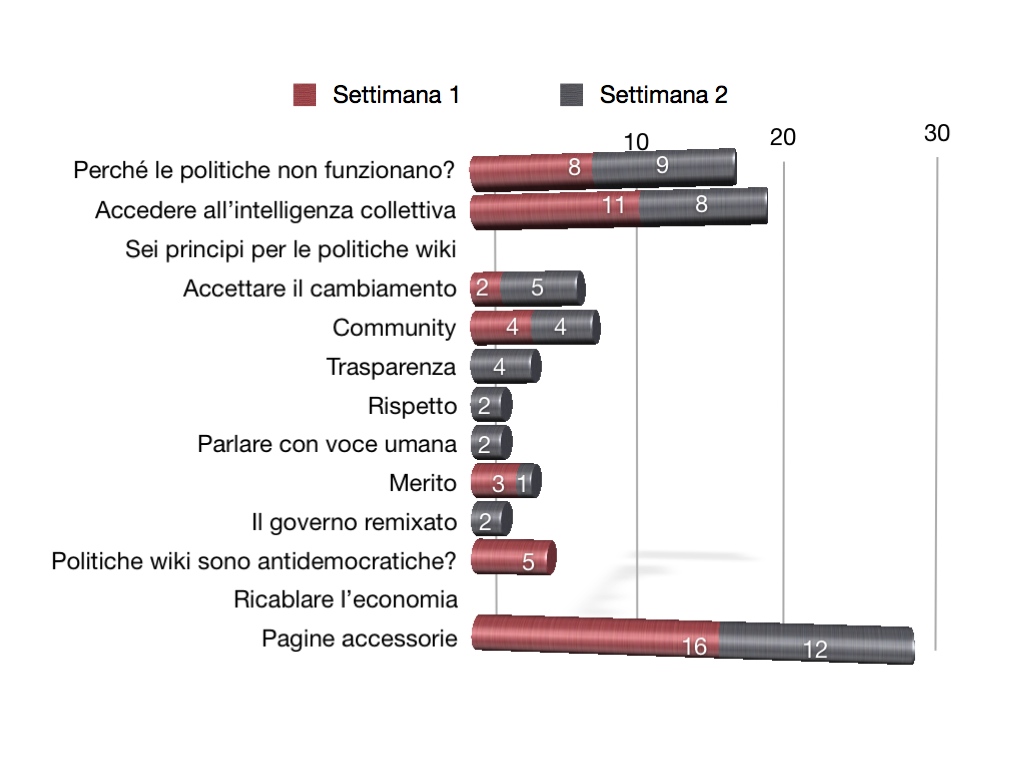
Siamo a metà percorso: due settimane trascorse da quando la bozza di Wikicrazia è online, ancora due prima di ritirarsi a scrivere la versione finale. In questa seconda settimana ho ricevuto altri 49 commenti (98 sulle due settimane); di questi, 37 sono stati sui capitoli veri e propri, 12 sulle pagine accessorie o i post di accompagnamento (nella prima settimana i numeri corrispondenti erano 33 e 16). Le persone che hanno lasciato commenti di merito sui capitoli del libro sono 18 (vedi la Hall of Fame); quasi tutte hanno commentato più di un capitolo, e infatti ormai ci sono commenti su tutti i capitoli tranne il 3 (che in effetti è molto breve, c’è poco da commentare) e il 12. Grazie di nuovo!

La mia impressione della settimana 2 è che il dibattito si sia approfondito molto.

  1. Alla voce “controllo dei fatti” è arrivato un contributo davvero utile: il team Rossella Tarantino-Ida Leone ha scovato l’accordo di programma quadro (APQ) che dava il via alla costruzione del collegamento ferroviario Matera-Ferrandina: è uno degli esempi per che faccio nel capitolo 1. E’ un accordo molto “inclusivo” e interistituzionale, visto che coinvolge la Regione, due ministeri e FS spa, ma questo non gli ha impedito di fallire: a oggi, Matera non è collegata alla rete ferroviaria. Altro contributo confortante è quello di Max Selvaggi, che approva la mia versione della storia di Visioni Urbane al capitolo 4. Federico, invece (bravo!), scova un mio errore nel capitolo 8.
  2. Alla voce “storie istruttive da aggiungere al libro” Giulio Quaggiotto propone un controesempio che faccia da contraltare a Italia.it: il caso di The Rewired State, davvero impressionante per efficienza. Anche Federico propone storie (recenti) di trasparenza per rimpolpare il capitolo 6; ma forse l’aneddoto più divertente è quello riportato da Francesco Silvestri, e che riguarda l’allenatore Fabio Capello. Monumentale!
  3. Ma la voce più calda della settimana è senz’altro quella della sfida sui concetti fondamentali. Molto del fuoco si concentra sul capitolo 2: Luca mi chiede di approfondire l’argomentazione “l’intelligenza collettiva esiste”, invece di limitarmi a citare Shirky; Tito e Tommaso non sono molto convinti che l’interazione in rete facciano emergere il meglio di ciò che i partecipanti alla rete, collettivamente, sanno. Ma c’è molto altro. Al capitolo 1, Susanna mi ricorda che i decisori locali sono in difficoltà per le politiche draconiane di tagli del governo; al 7, Francesco Silvestri ha dei dubbi che l’apertura eccessiva possa spianare la strada ai troll; al 10, Tommaso fa una critica ancora più radicale: si chiede se abbia senso parlare di wikicrazia: wiki va bene, ma se poi si deve esercitare un potere, un’azione sul mondo la burocrazia weberiana è davvero superabile? Io, naturalmente, provo a rispondere.
  4. Il bilancio della settimana è straordinariamente positivo. Ho un sacco di idee per migliorare il libro: una “burocrazia aumentata” à la Licklider per il capitolo 10; Bart e Lisa Simpson per il capitolo 9, e molte altre cose che poi vi dirò. Avanti così.

June 14, 2010     Alberto     Wikicrazia     comment

Lisa vs. Bart: why wiki policies are NOT necessarily undemocratic

David Osimo went to Forum PA to hold a keynote on e-government 2.0. He had perhaps the highest profile slot to address Italian public administrations, short of a cabinet appointment. Despite the success of his presentation, he is ot happy: everyone seems to agree that wiki government is a good idea, but there is very little action in the matter. Furthermore, he feels that the existing e-gov 2 initiatives are too elitist: designed, he says quoting the New York Times, for Lisa Simpson, not for Bart. David is somewhat disappointed.

Maybe he is right on European public administrations being too conservatives, his viewpoint is certainly more panoramic than mine. As for the elitism of wiki goverment, I think that’s a feature, not a bug. It works like this: in an oriented environment (i.e. where the values of rational open discussion and of meritocracy are shared and continuously reinforced: this makes all the difference) Internet-based tools filter the best contributions and bring them to the forefront. Lisa Simpson quickly becomes a star in the community. Bart finds it hard to produce quality content, so his contributions are normally ignored. The difference in quality is amplified by the continuous quoting and liking of Lisa’s contributions, so that the Internet-based community enhances the difference in prestige between brother and sister, leaving the former way behind. Peer-to-Patent, Evoke and Kublai are networks in which almost all the action is in the top one or two percent contributors. I explain this far better in Chapter 9 (of my forthcoming book: btw, you are very welcome to collaborate to it, click here for an English explanation).

Why do I like it? Because, if access to the system is open and encouraged (and this makes all the difference too: I discuss this in Chapter 11) and if the system is merit-based, e-government 2.0 is both more effective and more fair than old-style participation. For the same reason: namely, that it selects an élite which is not the usual old boys network, but rather a merit-based, emergent élite in which Lisa is gong to be a leader – as she deserves to be – rather than watch from the sidelines as Mr. Burns runs things in Springfield. As for Bart, the door has to stay open for him; but in the meantime, having Lisa rather than Burns in charge is a hell of an improvement, if you ask me.

June 9, 2010     Alberto     e-government 2.0, Wikicrazia     3 comments

Introducing: the book (with a little help from my friends)

In 2010 I’ll release a book on user generated policies. I am passionate about this subject: I think that the web 2.0 wind blowing on public authorities is a great chance to bring about a profound change in the way citizens concern themselves about public policies, making it more informed, effective, and even fun.

The book is called Wikicrazia – Government at the time of the Internet: understanding it, designing it, participating as a leader, and will be released on September 15th by Navarra Editore. It aims at reporting from the frontier of the subject (certainly I put the best of my knowledge into it), dealing with complex issues while staying reader-friendly and engaging. I worked on it for a year, and have now gotten to a draft we think is good enough for printing.

But we are not going to print it just yet. We are going to do something different: this is a book on collaboration on the Internet, and it makes sense to open it to collaboration on the Internet. No one is smarter than everyone, least of all I. So I’d ask you, if you have a little time to spare and you are intrigued, to help me write a final, improved version, the one that will get printed. You stand to gain my everlasting gratitude and a public recognition of your work on the book. To take part, or just to have a look at the draft, start here.

May 31, 2010     Alberto     Wikicrazia     1 comment

The Kublai files: harnessing the unexpected

David Osimo has been guest editing an issue of the European Journal of E-Practice bearing the significant title asked me to contribute to the “E-government 2.0: hype, hope or reality?”, and he asked me to contribute to it. I joined forces with Tito Bianchi, and together we produced a paper that summarizes two years of Kublai. The executive summary is this: web 2.0 can be quite a powerful tool fo public policy. But it is very, very much at odds with the prevailing administrative culture, which is still based on Weber’s idea of impersonal procedures, subject to controls that are aimed at verifying formal correctness rather than performance. If it is to go 2.0 at all, the State should guard the public interest while allowing and encouraging people to trythings out their own way. The full paper is called “Harnessing the unexpected” and can be read and downloaded here; David’ editorial is here.

April 22, 2010     Alberto     e-government 2.0     comment

Data to the people: the British government releases its datasets

Good news: sir Tim Berners-Lee convinced the British Gov to release its data for the public to use (thus spake BBC). data.gov.uklaunched in September; as I write it sports 2,879 datasets, and counting (in fact no one knows exactly how big is the mountain of data the British government – and all governments really – is sitting on). Developers seem interested: there’s already 29 apps running in those data, including the pretty spectacular Cyclestreets. The Mayor of London Boris Johnson wants to play too: he’s announced the opening of a digital warehouse with an initial 200 datasets relevant for the capital.

I find it hard to overestimate the impact of this move. Not only for the myriad of services that become possible, but also because it builds a place where hackers and civil servants are allowed – and indeed must – interact. In so doing, it facilitates the “coming together” of two cultures, the administration and the internet culture, whose alliance can really be a powerful force for modernity and civilization building, like I wrote after Wikicrats.

What about us Italians? It would be interesting to hear the opinion of some of those digital civil servants out there…

(Hat tip: Alberto D’Ottavi)

January 22, 2010     Alberto     e-government 2.0     comment

Perché le politiche pubbliche non funzionano? Due conversazioni a cui prenderò parte

Le politiche pubbliche user generated – come Kublai, tanto per guardarmi in casa – sono assolutamente marginali, poco più che un esperimento interessante. Per ora. Ma cosa succederebbe se diventassero una modalità normale e accettata dell’azione pubblica? Dopo tanto pensare, sento il bisogno di confrontarmi su alcune nuove idee che ho cominciato a elaborare a partire dall’estate.

Questa settimana il confronto comincia dall’Apegreen di stasera a Milano (al Subway, zona Turati, ore 19.30), a cui partecipo con Alberto Masetti-Zannini (The Hub Milano), Giovanni Petrini (Fa’ la cosa giusta!) e Filippo Solibello (Caterpillar).

Si continua giovedì sera con una cosa molto difficile: provo a mettere tutto in fila in una lezione online per Oilproject. Tenterò di capire perché le politiche pubbliche funzionano così male, e cosa possiamo fare noi tutti, armati d internet e buona volontà, per farle funzionare meglio. Il contesto è molto adatto a sottolineare la potenza della rete nel produrre beni pubblici: Oilproject è “una scuola virtuale – gratuita ed aperta a tutti – in cui si discute di attualità, Internet e Innovazione [...] senza alcun fine al di fuori di quello della divulgazione libera dell’informazione. Con più di 9000 studenti, Oilproject è leader italiano nel campo del free e-learning.” L’ha fondata Marco De Rossi. A budget zero. Quando aveva quattordici anni. QED, immagino.

December 1, 2009     Alberto     e-government 2.0     3 comments

OMG! The Italian government administration on Twitter

Last week the Bank of Italy held an important conference on economic policy towards the still lagging Mezzogiorno. Mainstream media appropriately focussed on the talks by President Napolitano and the Bank’s Governor Draghi. Far from the spotlights, though, the conference saw the debut of a small yet important innovation for the Italian central administration: the Twitter account of Sistema Nazionale di Valutazione (National Evaluation System), an initiative of the Evaluation Unit of the Ministry of economic development (home page). Its initiator is “civil servant 2.0″ Laura Tagle – obviously passionate about evaluation of public policies, who twitted in real time the highlights of the talks of Draghi, Barca and Giovannini.

If you use Twitter – and if it is not too much to ask – I would suggest you click here and then on the “Follow” button to stay in touch with Laura and the SNV. It is a small step, but it is in the right direction, that of using the Internet for an ever more transparent and accountable government – that’s why we participated in the Open declaration on the European public services process. If Laura and her colleagues feel the appreciation for what they are doing, chances are more people will follow their example, and we will all benefit from it.

November 30, 2009     Alberto     e-government 2.0     1 comment

PDF Europe, a first impression


Back from Barcelona, and time for a wrap up of Personal Democracy Forum Europe – also in response to a request for feedback from PDF Founders Andrew Rasiej and Micah Sifry. The conference is brand new to Europe, so it’s still in beta – and it has every right to be. Here’s what I experienced:

Personal approach of the organizers. Although somewhat of an outsider, I was made feel welcome at all times, thanks to a great team (though I do have a weak spot for Antonella).

Inspiring American presence. As seen from Europe, PDF has the great advantage of bringing over many interesting Americans that we can interact with – on our home turf! The American/European dualism kept surfacing and peppering the conversation.

High level of speakers. PDF EU convened some pretty bright people, with interesting things to show. Well worth getting to know.

High level of attendees Some really interesting people showed up, and we were able to have good conversations out of the spotlight.

Format issues. However, I did not always manage to make the most of those interesting speakers. The conference was mostly formatted into four-speakers panels with 6-8 minutes presentations and Q&A; presentations were in general too short to really delve deep into individual stories; Q&As were too short to morph into a real conversation. It ended up being, at times, annoyingly superficial. For example, when I got Irish blogger Mick Fealty to tell me about his story, his community and his vision it took me the best part of an hour to understand it well enough that I could make suggestions to him, and compare his project to other stuff I have seen or done. Mick and I did that over breakfast on Sunday morning: in the panels there was no time.

Two crowds or one? PDF EU had sessions on e-activism and sessions on e-government, and I am not sure that the two really belong together. Spin doctors and political advisors can be very interesting (think the Obama campaign, well represented in Barcelona), but I am not so sure that people like me belong with the same crowd as people like them. I see my role as that of a technical person. I designed Kublai to improve the effectiveness of regional development policy: whether I think regional development policy is a good idea or not is completely irrelevant. The democratic process resulted in laws and regulations saying there should be one, my job is not questioning it but making it work. The credibility of people like me – and ultimately our usefulness to society – depends on our ability to argue our cases without being suspected of partisanship. Of course, the skill set – if not the value system – overlaps across the two crowds, I guess we need to work out the conditions for they to be at ease with each other.
Finally, my presentation was a hit ;-) , having done my homework. The funniest remark I got (from two different people) is that Kublai is the first project they have come across which has actually found a use for Second Life! Just when did the Lindens get such a bad name?

November 23, 2009     Alberto     e-government 2.0     5 comments

Personal Democracy Forum: reinventare il governo partendo dalle Ramblas (con lo sconto)

Mi chiedono di parlare al primo Personal Democracy Forum europeo (quello americano si tiene già da cinque anni), che si farà a Barcellona il 20 e 21 novembre. Il PDF si occupa di politica e web, ma – almeno in questa edizione – anche di politiche, nel senso di policy. Tutta la seconda giornata è dedicata alla reinvenzione del governo, e in questo senso si spiega anche la mia presenza.

La lista degli speakers è abbastanza impressionante, e sono davvero onorato che mi abbiano chiesto di unirmi a questa specie di legione dei supereroi dell’e-government: Charles Leadbeater, Dom Campbell di Futuregov, Jack Thurston di Farmsubsidy, Tom Steinberg di Mysociety, David Osimo… Io partecipo a un panel che mi interessa molto. Il tema è se le politiche user generated di cui mi occupo (qui chiamate “we-gov”) siano in sync o, invece, in contrasto con l’uso del web in modalità 1.0, per veicolare contenuti dalle autorità pubbliche ai cittadini (“e-gov”); e la domanda è più sottile di quello che sembra. Il moderatore sarà Steve Moore di Reboot Britain; gli altri partecipanti sono Matthew Fraser, Tiago Peixoto e appunto Dom Campbell.

Se avete voglia di partecipare – Barcellona è bella anche d’inverno – potete risparmiare il 20% sul costo della conferenza. La pagina di registrazione è qui: nella casella “promotion code” scrivete “cottica09″. Se si iscrivono quattro persone con lo stesso codice PDF ci regala un ingresso gratis, quindi chiedo a chi dovesse usare il codice il favore di segnalarmelo (scrivetemi o lasciate un commento qui). In questo modo magari riusciamo a regalare un ingresso a qualcuno, o a rifondervi una parte del denaro speso. Ci vediamo sulle ramblas.

November 2, 2009     Alberto     e-government 2.0     2 comments

« previous articles   


© Contrordine compagni - Wordpress-Theme 0816 by Netprofit Webdesign & Robert Hartl and personalized by Freddy