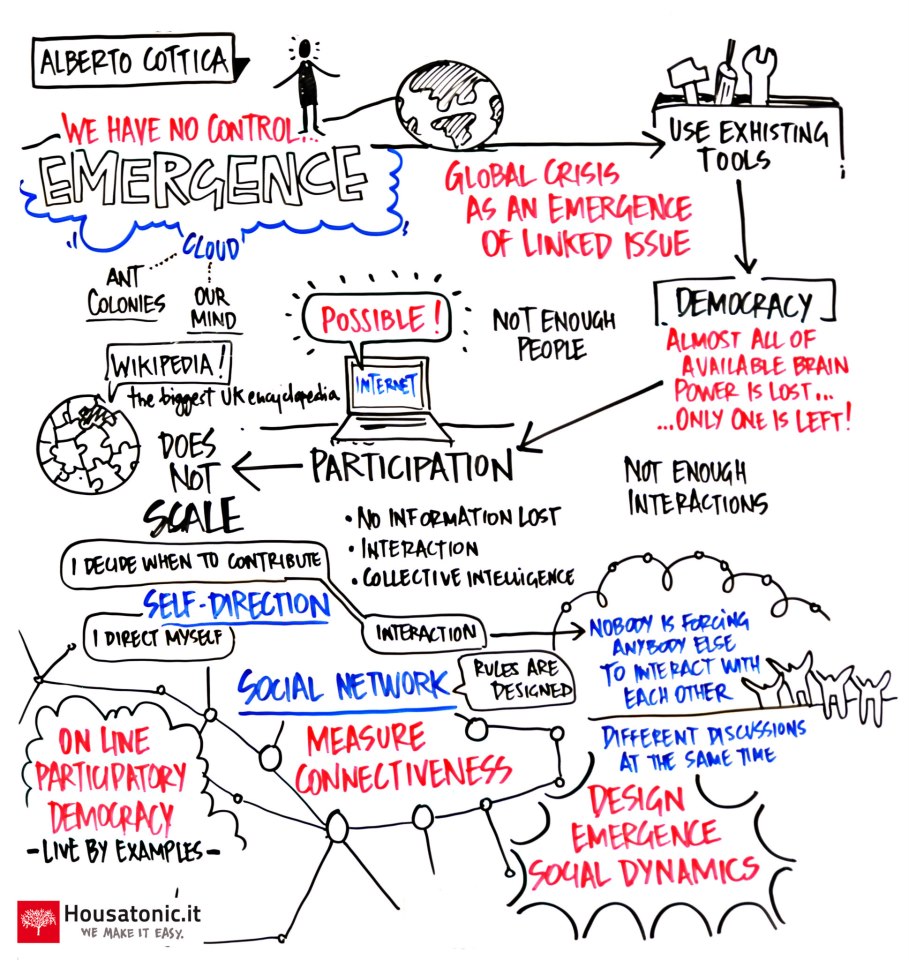
Last Saturday I took part in TEDx Bologna. Rather than play safe talking about the topics I developed in my book Wikicrazia, I talked about a connection that I am still exploring, and find absolutely fascinating. I am wondering whether we can:
- using network science to herd the social dynamics in open online communities (how?). Get them to look at issues care about; and to accept certain rules of mutual engagement, like basing your argument on evidence. Can we use online communities as tools for analysis and solution design to collective problems, as if they were computers composed of people?
- embed these online communities in a framework of democratic legitimacy, using them as open spaces for citizens to participate in taking apart societal problems and designing solutions. Legitimacy here means that such communities must be participated, and so somehow led, by democratically elected institutions.
Participants to these communities sign off to a deal: they accept interaction to be directed, rather than totally free (for example, these places are not the right ones to post pictures of cats). In exchange, they get to participate in a discussion which is close to, and participated by, public decision makers. So, such communities can make credible promises – carefully ringfenced and realistic – of the kind: “the gift of your time and effort will be reciprocated with influence on the decision we make in the name of the people and in the common interest”.
I realize this is a long shot: from network science to participatory democracy, through online communities. I hope my aim is true. The talk’s video will take about a month to get through post-production. The image below is just an appetizer.