
Tag Archives: open data

Open data: a game-theoretical argument

_MG_3105

On TechPresident, David Eaves makes a convincing case that a policy of open data makes a positive impact on governance even if citizens don’t seem to be reusing the data. Though citizen engagement is important, he argues, the number of downloads from open data portals is a poor measure of performance for those policies.

I would like to add another argument to his; one that is particularly well suited to contexts where the credibility of public authorities has been undermined by persistently poor results, scandals or other unfavorable conditions, such as my country of origin, Italy. It is this: when citizens are suspicious and distrustful, the simple act of putting data out there and making it easy to access, explore and reuse them tends to detoxify the critical citizen-institution relationship. “We have really got nothing to hide – says the dataset – It’s all right here for you to see.” “How bad can it be? – muses the disgruntled citizen – If there were something fishy, journalists and prosecutors could get right to it by a couple of mouse clicks.”

Game theorists have an elementary model calling burning one’s bridges: the idea is that, sometimes, it is possible to gain a strategic advantage by renouncing one’s escape routes. Since hiding facts is no longer an option, even a cynical, opportunistic decision maker is credible when she claims to be keeping to the straight and narrow path: after all, the only alternative is near-certain scandal, disgrace and possibly a jail term. Even more interesting, at least for me, is that open data make it more difficult for even the most hard-nosed of trolls to get away with the “everyone’s corrupt, they are all giving contracts to the old boys and their cousins” argument. That is difficult to disprove when there is no access to spending data; with open spending data, however, officials can simply answer “Oh, really? Well, help yourself to our dataset and tell us if you find anyone’s cousin in there, we will be happy to look into it for you.” This becomes a distinct possibility if you, like the city of Florence, release spending data in granular form (city spending is mapped to the individual invoice level). Credibility of an honest behavior from decision makers and reverting the burden of proof from them over to citizens both work in the sense of reducing mistrust and increasing societal cohesion.

So, dear governments, here’s a word of advice from game theory: open up your data, especially the spending data. No need to do a large program, you are welcome to stay on the cheap, but do it. Now. Don’t waste time trying to work out what the ROI of that is. That kind of exercise is not cheap and could take years – and trust me, you can afford open data. What’s the ROI of the social contract not breaking down?

Unless, of course, you can honestly claim that you enjoy a high level of trust by your citizens. Can you?
Civic hacking made easy: four small innovations to ramp up citizen involvement in hacktivism

I am still reeling from the impact of #SOD13, the first Spaghetti Open Data gathering. What they wrote about it, though a little overenthusiastic, is largely true. #SOD13 was a major energy high; it let us glimpse another possible world, and I am proud to have contributed to making it happen.

In my perception, a fundamental driver of #SOD13’s success was its uncompromisingly inclusive stance. Spaghetti Open Data was inclusive from day one, because we designed it that way. At the time (2010) I was thinking of a mutually respectful encounter between experts from different domains, hackers and civil servants, computer scientists and policy makers. #SOD13 aimed higher than that, all the way to the inclusion, as a protagonist, of anyone wishing to be part of the community. The problem was how to achieve this without watering down the gathering, without giving up on the opportunity to push to the edge the technical expertise of the more skilled members of the community. We wanted to boost inclusivity not by forcing everyone not to hack (which we could have done by, say, focusing on discussing the prime principles of open data), but by presenting participants with a sort of menu of things to do. Different items on the menu required different skills: programming, understanding and writing legal code, statistical data analysis, but also citizen engagement, data cleanup, monitoring. Each participants decided what she wants to do on the basis of inclinations and skills, and all these activities are part of a workflow to build technically complex projects. In this way, everyone involved, whatever his or her skill level, can jump in and be a civic hacker, immediately and in the narrow sense of the word. All it takes is being willing to get your hands dirty.

#SOD13 designed and deployed four of these activities.

  1. The non-technical hackathon. Led by two young lawyers passionate about open data, Morena and Francesco, one of the hackathon tracks revised the European Commission’s EPSI Scorecard for the part concerning Italy. A while earlier, we had noticed that these data were in urgent need of an update. The revision required half a day of work, a lot of web searching for supporting evidence, and a lot of patience, but it yielded an extraordinary result: Italy’s score leaped from 300 to 450, even with a conservative interpretation. The EPSI people thanked profusely the civic hackers in #SOD13 and updated its official site with our data. If, for once, Italy is proudly at the top end of a tech chart (in fourth position, after France, the Netherlands and the UK) we Italians owe it to them. In the same logic, SOD’s volunteers are manually populating the database supporting Twitantonio, an app that lets citizens find candidates to the upcoming elections: this work does not require more expertise than looking for someone on Twitter, but if it does not get done the app is useless.
  2. The monithon. This simple, elegant idea was proposed by the Opencoesione crowd. Opencoesione is a government project, and easily the largest-scale open data project ever deployed in Italy. The people in charge of it hang out in SOD since inception, well before Opencoesione was dreamed up, and I suspect that they got the idea from the mailing list. Monithon works like this: you query the Opencoesione database and find which projects near you your taxpayer euro went into. Then you go there, ring the bell and ask to see how it’s doing. I did not take part in this, but the report (Italian) is great. A bunch of Ministry wonks roaming the renovated schools of Bologna, on a Saturday, with citizens in tow? That’s a sterling silver punk attitude to monitoring in my book!
  3. The documentathon. Developers – especially in open source communities, where many contribute on their spare time and are unpaid – don’t like to write documentation for the code they write. Often they are spread thin across a project, and they simply don’t have the time for it. Result: tons of undocumented code, very difficult to make sense of, improve and even use. Even very rookie programmers with minimal can be very useful to a development project simply by adding comments to code written by others (“here we simulate clicking on the top right link”). If you want to see an example, check out this scraper, written originally by Vincenzo and modified and commented by me.
  4. The iron pact with the ladies. The hacker community has a problem, and that’s that women tend to stay away from it – so it loses half of its potential! After reading a sombering post by Asher Wolf, I asked the community for help in making SOD more attractive to women. That led to a fruitful collaboration with the Bologna chapter of Girl Geek Dinner on the whole three-day gathering. Also thanks to them and their Spaghetti Open Data Gender Survey, rolled out as a track of our hackathon, the female presence at the gathering was numerically strong and high quality on all fronts, writing code included. I intend to keep trying to do more to build female-friendly environments.

All in all, #SOD13 was definitely a step in the direction of “everybody is a civic hacker” – and that, as far as I’m concerned, is the right direction. We’ll see how it pans out.

TweetyourMEP: online two-way dialog with members of the European Parliament

Many observers have noted that most political leaders use social media mostly for one-way communication, as it they were a podium in an electronic square. The question is not so much whether they will change their approach, as whether citizens, changing their own approach to politicians online, will force them into a different communication style.

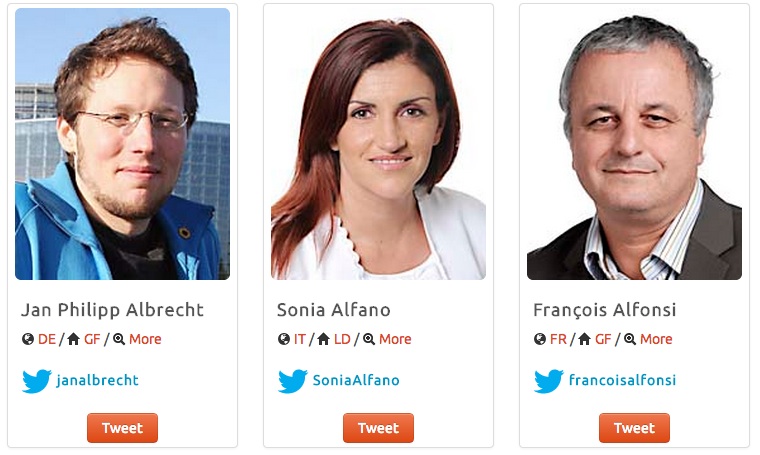
In the last week or so, a generous group of hackers and open data activists in the Spaghetti Open Data mailing list has cooked up an app called TweetyourMEP. It reuses the dataset of EPNewsHub, an aggregator of social media activity of members of the European Parliament. With the same data, TweetyourMEP takes a very different road: rather than enable MEPs to inform us on what they think and do, they enable us to let them know what we think and care about. And no, it is not like writing letters to your representative. There is a critical difference: letters (or emails) are private – no one sees whether I have written to a political leader, nor whether he or she replies. This makes engaging with individual citizens a pretty inefficient use of time (some MEPs have constituency of millions of voters). Tweets, on the other hand, are public: a MEP engaging citizens on Twitter is making a more efficient use of her time, because she is being seen to engage by everyone in both her own and that citizen’s social network.

TweetyourMEP è un piccolo atto d’amore per la democrazia europea da parte dei civic hackers italiani. Usatelo con orgoglio e rispetto, diffondetelo, aiutateci a migliorarlo. E avanti così.TweetyourMEP is a small act of love for European democracy from Italian civic hackers. Use it with pride and respect, spread the word, help us improve it. And keep up the good work!