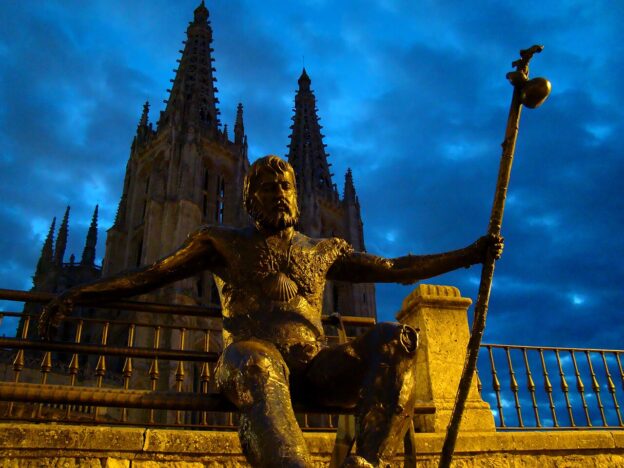
I have just returned from walking St James’s Way. It is perhaps the most famous of the medieval pilgrimage routes: for twelve centuries pilgrims have walked it to reach the cathedral of Santiago de Compostela, in northwestern Spain, and they still do. According to tradition, the apostle James is buried there; since the early Middle Ages, the church has granted an indulgence to pilgrims that make it to Santiago. The flow of pilgrims towards Santiago is believed to never have stopped since the Middle Ages. In modern times, it shrank to a trickle, but has been growing at double-digit since the 1990s. It is estimated that over 500,000 pilgrims walked 100 kilometers or more in 2024.
To walk the Way is to participate in a subculture in which it makes complete sense to set aside a month of your life so that you can walk six-seven hours a day, sleep in crummy hostels, deal with foot blisters and minor (and sometimes not so minor) injuries. It may sound counterintuitive, but people take to this kind of stuff so easily that I suspect it may be hardwired. Maybe we are evolved for the collective nomadism we practiced before agriculture? I have no idea. Certainly the same ease of adoption applies to endurance sports like long-distance running and its even more extreme cousins, triathlon and iron man competitions: they seem weird from the outside, but their popularity speaks for itself. You will be hard pressed to find extrinsic rewards that justifies these huge investments of time and effort. The simplest explanation for why so many people walk St James’s Way or run marathons is that they enjoy doing so. And that takes me to Keynes.
In 1930, John Maynard Keynes wrote a landmark essay, Economic Possibilities for our Grandchildren (full text). The Great Depression was raging on, but he refused to despair. Yes, the rate of technological change had temporarily outpaced the rate with which “we can find new uses for labour”. But the Depression was just a sideshow. Based on a conservative estimate of a 2% yearly increase in the stock of capital, and a 1% yearly increase in efficiency due to technical progress, Keynes concluded that “mankind is solving its economic problem”.
I draw the conclusion that, assuming no important wars and no important increase in population, the economic problem may be solved, or be at least within sight of solution, within a hundred years. This means that the economic problem is not—if we look into the future—the permanent problem of the human race.
John Maynard Keynes, “Economic Possibilities for our Grandchildren”
He then went on to argue that abundance is likely to cause disorientment and anxiety to “the old Adam” as the fifteen-hours working week rolls in. Our species has toiled for so long to scrape together a living that, when it finds itself in an age of abundance, it will simply not know what to do with itself. This problem was, to him, not overly concerning. It would surely solve itself as new mores evolve; meanwhile, “there will be no harm in making mild preparations for our destiny, in encouraging, and experimenting in, the arts of life as well as the activities of purpose”. Keynes walked the talk: though he was by then the world’s most renowned economist and the architect of Bretton Woods, he found the time to be the first Chairman of the Arts Council of Great Britain.
Keynes had his numbers right. His back-of-the envelope calculation of the prevailing rate of capital accumulation was not far off the mark. The “economic problem” – defined as the problem of producing enough to provide everyone with what was considered an adequate living standard in 1930 – is indeed solved. Most criticisms of Economic Possibilities focus on his failure to account for the role of positional goods, and to predict that capitalist enterprises would invent advertising as machinery to create more wants, so that workers in advanced countries would need to keep working long hours to satisfy them. His take on “the old Adam”’s psychological need to toil in order to feel useful is not usually challenged.
The reality of St. James’s Way, though, does challenge it. Many are the people like me, who have the privilege of taking substantial time off work and decide to use it on a 800 kilometers pilgrimage, despite (or because of) the discomforts associated with it. Maybe most people would walk the Way, or spend time and energy of some other idiosyncratic endeavour, if they had the same privilege. Economists think of this situation as a backward-bending labour supply curve: the higher the salary, the less time people devote to working.
The Black Death (1346-1353) is thought to constitute a natural experiment on the shape of the labour supply curve. A terrible plague wiped out about half the population in Western Europe. As the continent emerged from the plague, labourers found themselves in high demand: the number of available hands had dwindled, whereas the extension of land to be farmed had stayed the same. This engendered a period of high labourer salaries, known by historians as “the Golden Age of Labour”.
Confronted with greatly increased salaries and a general decrease in agricultural rents, medieval farmhands do not appear to have reacted pocketing the extra money. In many cases, they exploited their newfound market power to work less – in Koyama’s formulation, “they consumed their income increase in the form of leisure”. In England the number of official holidays that did not fall on a Sunday rose from the 20-27 pre-Black Death to the 38-43 of the 1450s. Contemporary writers from Mandeville to Petty agreed that workers had a strong preference for leisure and would work until their needs were me, and no more.
So what did medieval peasants do with the extra time? They participated in religious festivals, processions, carnivals, merrymaking. Some, I suppose, must have decided to walk St. James’s Way or other pilgrimage routes. Far from complaining, “old Adam” seems to have kicked back and enjoyed the ride.
Interestingly, this is an economic problem where science fiction authors have weighed in. Two in particular: Iain Banks and Kim Stanley Robinson. Banks is best known for his much-loved Culture Series. The eponymous Culture is a pangalactic civilization which wields such advanced technology that scarcity has been completely eliminated. Culture citizens spend their time engaging in arts, extreme sports (like something called “lava rafting”, which is exactly what you imagine it is), partying, flirting and developing highly specific interests (for example fanbases of individual starships).
Robinson’s Mars Trilogy depicts the first 200 years or so of colonisation of Mars. The first years are very hard as the colonist struggle to get a foothold; then political strife with Earth and revolution absorb everyone’s attention and time. But, by the third book in the series, people are getting serious at having fun. You guessed it: traveling, partying, making art, extreme sports. Robinson goes to the length of imagining a race that is a cross between an ultra-ultra-marathon and orienteering, and runs all around Mars’s equator.
It was coming time for the Round-the-Worlder, which began every other perihelion. Starting from Sheffield the contestants could run east or west around the world, without wristpad or any other navigational aid, shorn of everything but the information of their senses, and small bags of food and drink and gear. They were allowed to choose any route that stayed within twenty degrees of the equator (they were tracked by satellite, and disqualified if they left the equatorial zone), and all bridges were allowed, including the Ganges Strait Bridge, which made routes both north and south of Marineris competitive, and created almost as many viable routes as contestants.
– Kim Stanley Robinson, Blue Mars
It may be that Keynes, free spirit though he was, was inadvertently making a normative moral statement, rather than a descriptive psychological one. Not “the common people are going to be uncomfortable and rudderless if they do not work a full time job”, but rather “society cannot be stable unless the common people are occupied selling their labour so that they do not go hungry”. Certainly the latter position reflects the prevalent view of 19th century English élites (I am also re-reading Karl Polanyi’s The Great Transformation, which has a lot to say on the matter).
Whatever Keynes’s reasoning, the people I met on St. James’s Way agree with Iain Banks, Kim Stanley Robinson and medieval peasants, and disagree with him. When (relatively) free from need, people do not face the loss of meaning Keynes attributes to “old Adam”. Instead, they embrace (or invent) deliciously whimsical endeavours such as walking 800 kilometres to visit the shrine of an Apostle. I have no doubt that, should technology allow it, running around Mars’s equator and rafting on lava would find their own crowds of enthusiasts. Through these activities people meet new people, brag about their achievements, flirt and fall in love, and are at their happiest and most human, most of them far more so than when they are working a job. For what is worth, I agree with them too, and wish to dedicate my own work to bringing about a sustainable, time-rich society where we can stop inventing fake needs for each other, provide for the needs (not the artificial “wants”) of everyone, step down from the daily grind, and walk, or run, or raft, to our hearts’ content.
Photo credit: Bjørn Christian Tørrissen – http://bjornfree.com/galleries.html CC BY-SA 3.0