In my lifelong quest for economic alternatives, as was inevitable, I came across David Graeber and David Wengrow’s The Dawn of Everything, a book entirely dedicated to arguing, on the basis of ethnographic and archaeological evidence, that Margaret Thatcher was wrong to claim that “there is no alternative” to neoliberal economic policies. I read it in 2022, and wrote a review that emphasized this sense of possibility. It was fun and inspiring to watch, through the words of the Davids, all these different human populations invent economic and social institutions that helped them live in the way that they thought desirable. All this diversity made it clear that there are, in fact, plenty of alternatives. To how we organize our economies.
In the same year I started working on the project of a cohousing in Brussels, The Reef. In my mind that, too, was an attempt to follow my contrarian star, and look for an alternative approach to housing and even family life. In that sense, our project aligned well with the main thrust of The Dawn of Everything, and it still does. But it was an unremarkable alignment: housing is one of the essentials that an economy must provide, and we were providing it in an unorthodox way. That is possible because, once more there are alternatives. True, but obvious.
But then we got in the thick of actually building the cohousing, and my way of looking at it changed.
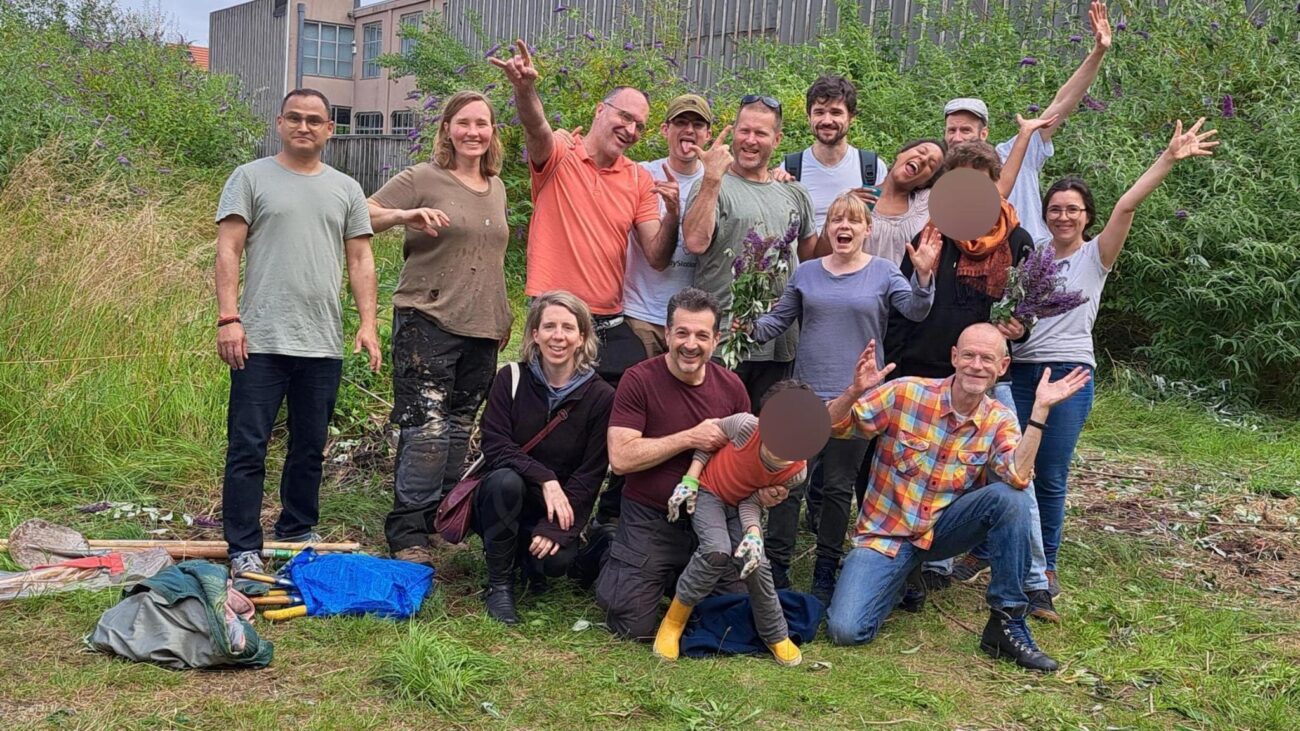
I had my first epiphany in the summer of 2024. We were doing some due diligence on a plot of land. As part of that, we hired a company to take samples from the plot’s soil to look for polluting substances. They took one look at the plot and told us we needed to clear a path for their truck to go deep into it and drill their holes. So we showed up one Saturday morning with gardening tools, looked at each other and shook our heads: the plot was overgrown with tall, thick buddleia bushes easily four meters tall. We were in for a week of hard work. Well, better get to it then! We grinned at each other, marched in and… three hours later the job was done. It had even been pleasurable, physically hard but psychologically regenerating. It turns out that a dozen people working together can be very efficient. That was cool, but what did it mean for the cohousing? Was there any undiscovered resource, any hidden superpower we were failing to exploit?
About a year after that, I had an answer. We had ended up buying that plot, and were in the phase of designing our future cohousing. As they were working on putting a price tag on the operation, our architects asked us whether we wanted to install any rooftop solar panels. It turned out that the European Union has a policy to incentivize the mutualization of the production and consumption of energy. To take full advantage of it, you need to start a special type of company called an energy community, or join an existing one. We decided to look into the matter. It took some meetings and learning to tweak some Excel macros and interpret their results, but those results were unambiguous: an energy community is an obviously good idea for The Reef. It helps decrease carbon emissions, saves us money and gives us some resilience in the face of blackouts or brownouts. We are definitely starting one as soon as we move in.
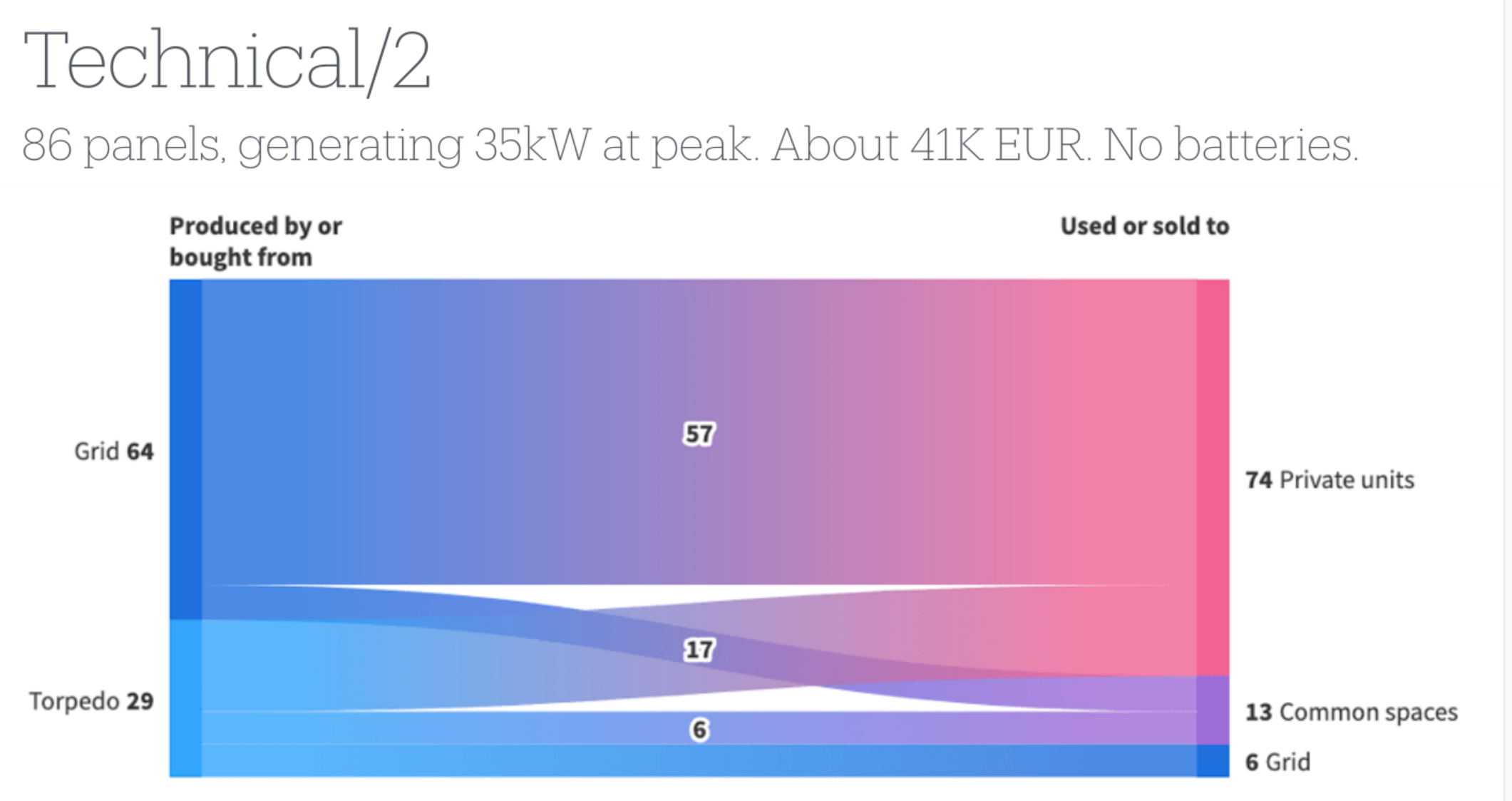
The decision felt, and was, easy, But this was because:
- Someone had collected and processed the relevant information, synthetized it into an format accessible to those who had not been involved, and reported to the whole group.
- The group had been able to reach an agreement, including on who should pay for the initial investment (spoiler: not a problem, energy communities produce a bankable revenue so you can even borrow the money from a bank).
- The formalities of starting an energy communities (an incorporation, a statute, a board, a bank account, legal responsibilities…) were considered trivial, in the sense that we are confident that a few people from our number will take them on without much drama.
These conditions are not in place for everyone, and that is the reason why most people are not part of an energy community (in late 2025 there were about 8,000 such communities in the EU, or one for every 50,000 Europeans). But they are in place for us, because the cohousing itself created them. There are two of these conditions:
One is trust, and believe me: building a 10 million Euro project where you invest your life’s savings with someone will either fail or result in mutual trust. This trust translates into what economists call “low transaction costs”, meaning that making a new agreement (starting an energy community) is much easier between people that have already made one (building a cohousing) with reasonable success. The other condition is capacity. We can now count on about 30 adults: everyone has different strengths, and of course everyone is busy living their lives. Yet, we will almost always be able to find a few hours of time from those of us who can look at an Excel sheet, see an opportunity, and explain it to the others. In a single household or a smaller group, that is harder, as the necessary skills might not be there, or might reside with only one individual with very little time – think of parents of small children.
And that takes me back to The Dawn of Everything. Based on native American sources, the Davids propose that equality is not a matter of redistributing things, but of making sure no one has much power over anyone else to begin with. Without accumulation of power, the accumulation of wealth will not get very far. This is what economists call pre-distribution: the economy is arranged in such a way that the good life (proxied by income and wealth) is more or less evenly distributed. And how is accumulation of power prevented? By providing substantive (as opposed to formal) freedoms. In particular, three. In the authors’ words:
(1) the freedom to move away or relocate from one’s surroundings; (2) the freedom to ignore or disobey commands issued by others; and (3) the freedom to shape entirely new social realities, or shift back and forth between different ones.
I see now that cohousing acts as a scaffolding for Graeber and Wengrow’s third freedom. Because of trust and capacity, a group a few dozens strong can realistically achieve all sorts of social arrangements. The energy community is a good example, but by no means the only one. We are also planning to start a solidarity purchase group (Belgian GASAP – there are similar structures with different names in France, Italy, Japan and elsewhere), a cultural association and a scheme to offer local children some help with their homework. We are even already active in the neighbourhood association, which we joined four years before moving in!
In philosophy and economics, the idea of substantive freedoms is associated with Amartya Sen. In a genius move, Sen proposed that substantive freedoms (which he also called capabilities) are both the means and the ends of social and economic development. Development makes you free, by giving you more capabilities. And as more people are endowed with more capabilities, development accelerates, because more people use those capabilities to do things like start companies, or cohousing projects, or energy communities. Graeber and Wengrow’s contribution is to point out that collaboration – based on trust between, and capacity of, the people that are collaborating – is a capability that begets even more of itself.
So, our little cohousing project is already making us more free. I look forward to exploring this freedom.
