Grazie a Scribd. 🙂

Come sono diventato una hit editoriale involontaria
Leave a reply
Navigating the world by trial, error and dead reckoning
Grazie a Scribd. 🙂
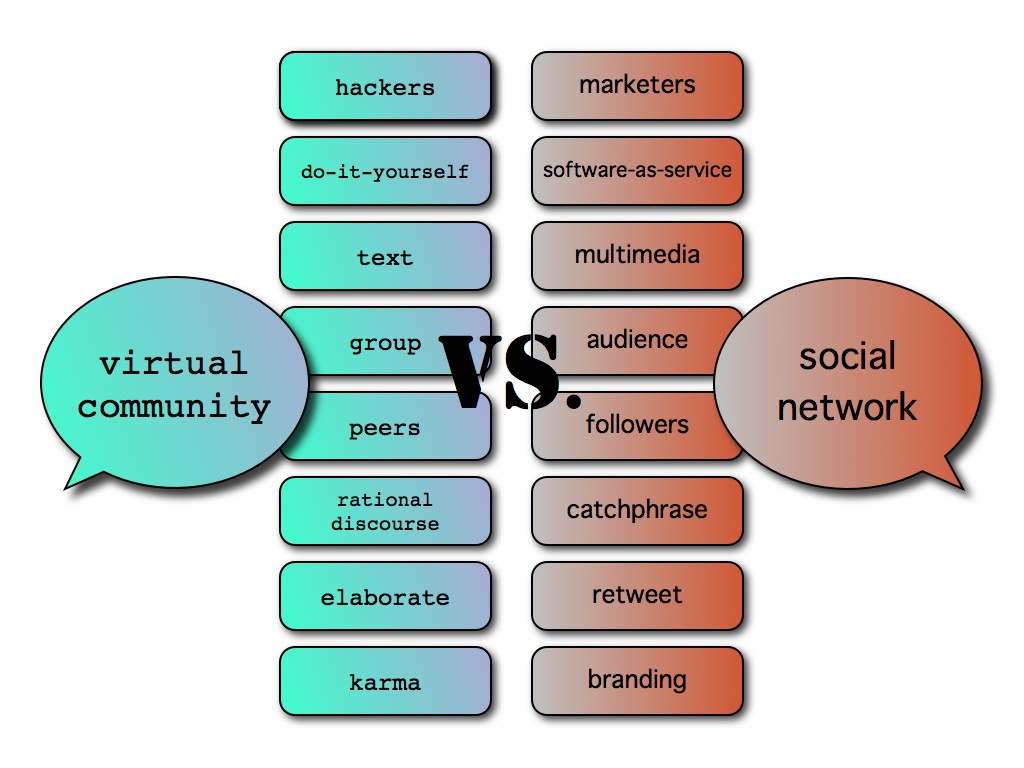
As I re-read the excellent The virtual community, I can’t help comparing the sense of “communion” that Rheingold associated with the WELL with the displacement I sometimes feel on social networks a.d. 2009, described very well by Enrico in his farewell to Facebook (in Italian). How did we end up here, if the Net in 1993 was that described by Rheingold?
I am wondering whether this has anything to do with the business-endorsed effort to reinterpret the Net as a tool for brand communication and marketing. I have nothing against marketing, which is the source of livelihood for many people who are dear to me, online an offline. But I don’t like that in modern-day social networks your “friends” are sometimes people, sometimes companies, sometimes people who, at times, speak for companies. Advertising is pervasive, sometimes in a sneaky way – so that you find ourself exposed to promotional messages in a relational context, without warning. It’s like inviting some friends over for dinner, and one of them uses the gathering to try to sell insurance bills to guests. It’s embarassing. And its net effect is, predictably, mistrust: every human contact on the net begins to feel suspicious, banalized.
In the 1600s, in England, enterprising individuals started to build fences around the traditional common lands to farm them, and appropriate the proceedings. That destroyed an important economic resource for the poorest families; but it was not forbidden. It would have been stupid not to take advantage of it. If they had not done it, others would. An annihilation of the common lands ensued. Now, it seems to me, the transition from virtual communities to social networks implies the annihilation of the digital commons” – created by government-funded research in the Sputnik era, and now appropriated by business for advertisement and entertainment purposes: with the additional problem that, weakening the hacker ethics of sharing, it is not clear what will happen to the Net’s formidable innovation-enabling capacity. It is legal, certainly. I ask myself, and you: is this unavoidable?
UPDATE: qui la discussione su Friendfeed.
Sto rileggendo il bellissimo The virtual community, e non posso fare a meno di paragonare il senso di comunione che Rheingold avvertiva sul WELL nel 1993 (lo chiama proprio “communion”), con quello di estraneità che mi accade talvolta di provare sui social network del 2009, e che ha espresso molto bene Enrico nella sua nota di addio a Facebook. Cosa ci facciamo qui? Come ci siamo finiti, se la rete del 1993 era quella descritta da Rheingold?
Mi chiedo se questo abbia a che vedere con il crescente protagonismo in rete di persone e imprese che cercano di rileggere Internet come uno strumento per la comunicazione aziendale e il marketing. Non ho niente contro il marketing e la comunicazione: persone a me molto care, sia in rete che fuori, si guadagnano da vivere proprio in questo campo. Ma non mi piace che nei social network moderni non sia sempre facile capire se i tuoi “amici” sono persone, aziende, a volte persone che in certi casi parlano a nome di aziende. La pubblicità è pervasiva e lo è a volte in modo subdolo, per cui ci si ritrova esposti a messaggi promozionali in un contesto relazionale senza preavviso. E’ come se invitassi degli amici a cena, e uno di loro usasse l’occasione per tentare di vendermi una polizza assicurativa. L’effetto netto di queste cose, com’era prevedibile, è la diffidenza: ogni contatto umano in rete comincia ad apparirti sospetto, banalizzato.
Nel 1600 inglese persone intraprendenti cominciarono a recintare le tradizionali terre comuni (commons) per coltivarle e appropriarsi del relativo profitto, distruggendo una risorsa economica molto importante per le famiglie povere, ma non era proibito. Sarebbe stato stupido non approfittarne. Se non l’avessero fatto loro l’avrebbero fatto altri. Ne seguì l’azzeramento completo delle terre comuni. Mi sembra che il passaggio da comunità virtuale a social network comporti un’azzeramento dei commons digitali, creati dalla ricerca governativa dell’era Sputnik e oggi appropriati dalle aziende a fini di promozione e intrattenimento; con l’aggravante che, venendo a mancare lo spirito di condivisione dell’etica hacker, potrebbe rallentare anche il formidabile generatore di innovazione che la rete è stata fino a oggi. Mi chiedo, e chiedo a voi: è inevitabile tutto questo?
UPDATE: qui la discussione su Friendfeed.